
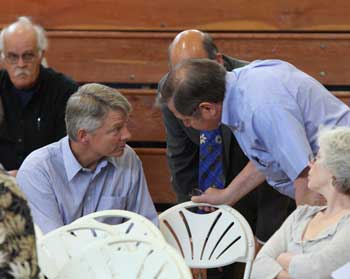
From left, Bill Johnson, Joe Sudol, and Ron Ricci strategize during Town Meeting. (Photo by Lisa Aciukewicz)
Before Annual Town Meeting (ATM) was gaveled into session at 9 a.m. last Saturday, according to Board of Selectmen Chairman Ron Ricci, the Planning Board, Board of Selectmen, and Economic Development Analysis Team (EDAT) members had been meeting to negotiate the wording of Article 29. Up until that morning, the Planning Board had serious reservations about the measure. Although there were residents who also had reservations, even after wordsmithing of the article, and voted accordingly when the vote was called, Moderator Bob Eubank declared that the article had passed by a majority.
At issue were objections by the Planning Board to the establishment of a “standing committee” and to the role of the proposed new board, the Economic Development Committee (EDC). In an interview with the Press Tuesday, Planning Board Chairman Joe Sudol said that the board had originally objected to the language defining the new committee, saying that “it seemed like the EDC is another Planning Board,” capable of functions such as zoning and planning, which are the responsibility of the Planning Board.
The language in question was published in the Town Meeting warrant booklet and posted on the town website. It asked the Board of Selectmen to “define and appoint a standing Economic Development Committee to act on the behalf of the town for the proactive planning and implementation of desired commercial development in Harvard’s Commercial District.”
That language was changed in a handout at Town Meeting: the revised article called for the selectmen to “appoint a standing Economic Development Committee (EDC) to continue the initiative for commercial development in Harvard’s Commercial District.” The revised wording proposed that “The Board of Selectmen will define the EDC mission, specify its responsibilities, set goals for the committee, and periodically review progress against these goals.”
However, the Planning Board remained unconvinced and continued to withhold support for the article until the morning of Town Meeting.
Between 8:30 and 9 a.m, according to Ricci, the Planning Board, selectmen, and EDAT members debated appropriate language for the article until both the Planning Board and EDAT agreed on new wording. The final version of the article approved by the voters asked the Board of Selectmen to “appoint an Economic Development Committee (EDC) [“standing” omitted] to continue the initiative for commercial development in Harvard’s Commercial District. The Board of Selectmen, in conjunction with the Planning Board, will define the EDC mission, specify its responsibilities, set goals for the committee, and periodically review progress against these goals.”
Selectwoman Marie Sobalvarro offered a “friendly amendment” to the article, changing one of the EDC’s tasks to “identify and advise the Board of Selectmen of potential town-approved infrastructure improvement projects for the Commercial District.”
At a Planning Board meeting on May 3, Sudol indicated that he would be working very closely with the new EDC and ensuring that the new board will “follow the letter of the law.” Sudol said that he agreed to the changes but was not happy about them and had allowed them in order to ensure that the Town Meeting vote mandated the inclusion of the Planning Board in the process.


