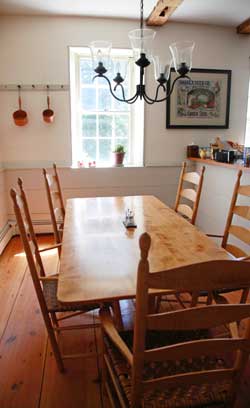
The dining room in the former Shaker Meeting House is one of the sights on the house tour. (Photo by Lisa Aciukewicz)
The Harvard Historical Society is calling its upcoming Shaker Village Tour “a rare opportunity” and “a once-in-a-lifetime event.” For the first time, the grounds and original buildings, now private homes, will all be open to the public, drawing Shaker enthusiasts from far away to view Harvard’s Shaker Village in September.
“We’ve had a lot of out-of-town interest from Chicago, Pennsylvania, New York, elsewhere,” said Historical Society President Denis Wagner, who personally persuaded the homeowners to participate.
Other organizations have sponsored architectural tours in the past, but those have been for members only and with access to one or two buildings, said Marc Sevigny, who has been restoring and stewarding the South Family house on South Shaker Road.
“This event, providing access to all remaining Shaker buildings in Harvard, is unique, as far as I know,” he said.
“It’s never happened before and may never happen again, or at least for a very long time,” said Judy Warner, Sevigny’s neighbor and a resident in the village district for 38 years.
A spiritual community
Harvard played a pivotal role in the history of the Shakers, one of the most successful of the Utopian societies in the nineteenth century. Harvard’s Shaker community, which has been called the spiritual home of Shaker founder Mother Ann Lee, was the second Shaker gathering in the country and the first in New England.
From 1781 until two months before her death in 1784 at the age of 48, Lee used Harvard as a base for her New England missionary work. She had found a receptive audience among followers of deceased New Light Baptist preacher Shadrach Ireland. The group was living in Ireland’s house, now known as the Square House, on Shaker Road.
In an age of evangelism, many were drawn to the charismatic Lee’s conception of a Christian duality in which Jesus Christ was the masculine, and she the feminine, embodiment of God’s spirit. Lee believed in revelation through visions and espoused celibacy for spiritual purity, an obsession some have attributed to her experiencing four stillbirths and the early deaths of all four of her other children.
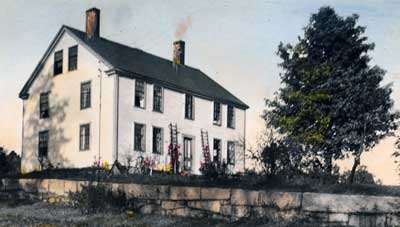
The Square House on Shaker Road was the home of Mother Ann Lee. (Photo by Eleanor Willard Merrifield, courtesy of Harvard Historical Society.)
As more people were attracted to Lee’s theology, some of Harvard’s townspeople grew nervous. Harvard Town Meeting voted to “consult and determine on some means to remove the people called Shaking Quakers who are collected in this town.” Some historians suggest that Harvard’s unsuccessful attempts to drive out the Shakers, including beatings and whippings, contributed to the Shakers’ later communitarianism and even to Lee’s early death.
By the mid-1800s, the north Harvard community had become a spiritually and economically thriving Shaker village with almost 200 believers. The Shakers’ emphasis on efficiency and hard work and their appreciation for technology, along with “the world’s” respect for their honesty and quality products, made them successful in several businesses, including packaged seeds, medicinal and culinary herbs, applesauce, and distilled rosewater. In 1848 alone, the Shakers processed over five tons of herbs and roots, according to entries in Elisha Myrick’s journal.
Shakerism declined after the Civil War and, one by one, the more than 20 communities in New England, Ohio, Indiana, Kentucky, and Florida closed. The Harvard village was sold to Fiske Warren, a successful Boston paper manufacturer, for his own social experiment, a single-tax enclave. After Warren’s death in 1938, his holdings were broken up and sold.
Only three Shakers remain at the Sabbathday Lake community in Maine. But Shaker values and aesthetics have had a lasting influence on art, architecture, and aesthetics.
Shaker immersion
Today, the layout of the Harvard village and its fields is hidden by trees, and residential growth. The large barns, once the largest in New England, are gone, and several of the buildings burned, were torn down, or were moved. With the exception of the town-owned Dry House, the remaining Shaker buildings are all private homes whose owners balance stewardship of their historic buildings with the activities of daily living.
Visitors will have a chance to visit the Square House, Meeting House, New Trustees Office, Ministry, Second House, South Family Dwelling, Tailor Shop, Carpentry Shop, Sisters’ Shop or Applesauce House, and Dry House. Areas of Shaker significance will be accessible, but not all of the interior spaces.
Participants will want to take time to climb Maple Lane to Holy Hill, explore the grounds and field, and visit the Shaker cemetery with its famous “lollipop” markers.
“The tour is an opportunity to immerse yourself in the culture and history and to really get a feel for what it was like,” said Historical Society trustee Tammy Alfano.
The tour will include access to Fruitlands Museum and the Harvard Historical Society at 215 Still River Road on Saturday and Sunday, Sept. 15 and 16.
Fruitlands Museum’s Shaker collection is housed in the original 1794 Trustees Office, which Clara Endicott Sears bought and moved in 1920 to the newly opened Fruitlands Museum. In addition to its regular menu, Fruitlands Museum Café will offer a Shaker-themed lunch, for which visitors are recomadvised to make reservations.
The Harvard Historical Society will host an exhibit from its own Shaker collection. While going through its archives for the upcoming exhibit, society trustees uncovered a collection of photographs taken in the late 1930s by Eleanor Willard Merrifield from Still River, who was concerned about the deteriorating conditions of the village. Society trustee Tammy Alfano hopes to have available by tour time a book of the photographs, which document several now-lost buildings and include Merrifield’s narrative.

The South Family Dwelling House on South Shaker Road is just one of the properties that can be toured during the Harvard Historical Society’s Shaker Village House Tour, Sept. 15 and 16. (Photo courtesy of Harvard Historical Society)
Tickets for the tour are $60 for Historical Society members and $75 for nonmembers. To reserve a ticket, call the society at 978-456-8285. The tour is limited to the first 400 requests.