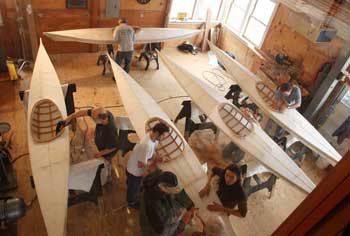
Kayak-makers work on their boats in Paul Richards’ Westcott Road workshop. (Photos by Lisa Aciukewicz)
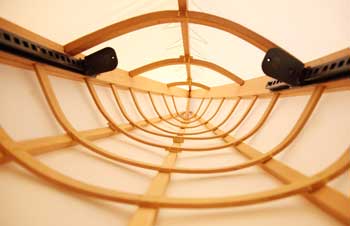
Interior of a skin-on-frame kayak.
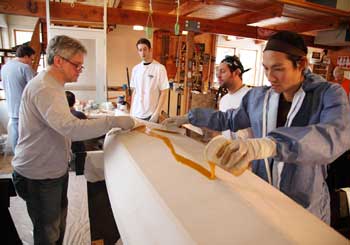
From left: Mike Mintz, Bart Morrison, Alan Mintz, Glen Cooper, and Kiliii Fish work on finishing a kayak by applying a two-part polyurethane coating to make the skin waterproof, UV-resistant, and highly abrasion-resistant.
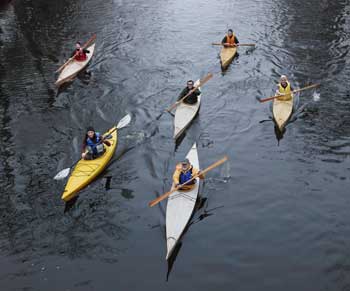
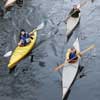
A fleet of newly created skin-on-frame kayaks heads out on the Nashua River on an unseasonably warm Jan. 13.
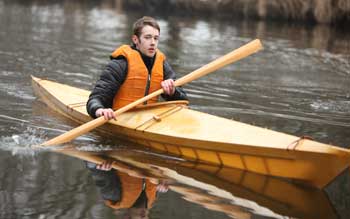
Alan Mintz tries out his new kayak. The finished kayaks weigh approximately 25 pounds—far less than kayaks made from plastic, fiberglass, Kevlar, or composite carbon.
“Before this project, I couldn’t even hang a picture; now I can say I’ve built a boat!” said Glen Cooper, a local photographer who lives on West Bare Hill Road, at the end of last week’s kayak-building workshop.
The workshop was the brain-child of Paul Richards, who hosted the ultra-light, skin-on-frame kayak-building event in his shop on Westcott Road. The class was led by Kiliii Fish, a twenty-first century Native adventurer and storyteller from Washington, who instructed attendees in using his own simple, innovative designs for skin-on-frame kayaks, which he has perfected during the past five years.
Over the course of eight straight days, until Sunday afternoon last week, a group of five men including Richards and Cooper spent eight hours a day in the workshop learning the basics of building a skin-on-frame kayak. Others in the workshop were Bart Morrison of West Bare Hill Road, Peter Dorward, of Still River Road, and the father-son team of Mike and Alan Mintz, Richards’ neighbors on Westcott Road.
As Fish laid out the details of his design, he encouraged participants to let go of their worries about making mistakes. He does this, he says, because his design tolerates imperfections, and he wants his students to experience the process as life-affirming. Participants seemed to take this wisdom away with them as they drove their kayaks home following a group launch on the Nashua River at Oxbow on Sunday afternoon.
“I found it to be a complex adventure,” reflected Richards. “Kiliii (pronounced KEE-lee) has an immense amount of knowledge and is a fantastic teacher….He could see what each of us was struggling with and gave each of us what we needed to let go of our ambitions for perfection. This was a learning opportunity that doesn’t end when the urethane dries. Now we have to use these things and keep learning and thinking about the lessons we learned this week.”
Richards’ plan to host the workshop came together quickly last December after he found seawolfkayak.com, Fish’s website, on which he promotes, among several of his artistic endeavors, an indigenous sea kayak workshop. When Richards saw that there were workshops to build indigenous-style sea kayaks from scratch, he contacted Fish and persuaded him to head east and stay in Richards’ studio shop, which had all the equipment needed for each step of the frame-building process.
Quest for a kayak
The quest for a kayak started at Bare Hill Pond this past summer, as two dads with their kids on the pond beach, Cooper and Richards, saw a paddler headed for open water. At that point, they agreed that a kayak was in their future “because it looked so freeing.” Later when Richards saw what he called a “neat-looking geodesic boat” on someone’s backpack at a boat show that summer, he began some research on light kayaks and found that the beauty and simplicity of skin-on-frame kayaks appealed to him the most.
Initially he was only looking to buy, Richards said, but after viewing Fish’s website, the thought of using his woodworking skills (Richards designs and builds movie sets) to craft a functional object of beauty shifted his focus to hosting a workshop led by Fish. So all he needed were some other like-minded people who would invest a full week of their lives in building a kayak alongside him. Within 24 hours of sending out an email to his friends, he had four who were willing to commit to a workshop, including Cooper.
“I didn’t really know if I could do this at the time,” admitted Cooper after completing his first solo run in the Nashua River on Sunday, “but I knew I’d regret seeing Paul in his kayak at the pond this summer, so I trusted Paul’s belief in Kiliii and just went for it.”
Mike Mintz had a different reaction to Richards’ email. He saw it, he said, as a great father-and-son project for him and his son, Alan. Alan agreed it would be interesting and probably a good project to write about for upcoming college essays. Things became a little uncertain for them last week, he noted, when Alan had to undergo some unexpected oral surgery and was unable to take part for three days. Nevertheless, by working on different phases of the project, they were both able to contribute, and it was Alan who took the first ride in the new craft.
The workshop ended Sunday evening, after the workshop was cleaned up and Kiliii packed up his tools to leave. Richards was tired, yet glowed with what he and his friends had accomplished.
“These boats are meant to be used, not sit around as objects that look great from afar, like other wood pieces or movie sets,” he said. “At the end of the day, these kayaks we made, with unique mistakes only each guy knows about, are ready to take us out to the pond or river—to the next adventure. This week we learned that it’s not about building a perfect thing; it is really about what the boat will take you to next.”