A sure sign of spring is the return of blackbirds to wetlands. (Photos by David Durrant)
As I write this, the pond is still covered with ice with just a little open water where the stream flows in, and there is snow on the vegetable garden, which is unfortunate because we have usually planted our peas, one of my favorite vegetables, by now. I have seen none of the returning migrants that are usually here at this time of year except for a flock of grackles. In years past we have had wood ducks and hooded mergansers on the pond, but without open water there is not much chance of them stopping by. I did see a pair of mergansers flying over but they kept going, and a friend saw a couple of wood ducks in the Delaney area.
On one of our walks down Brown Road I heard some red-winged blackbirds, but they were deep in a swampy area and I was unable to see them. The red-winged blackbird is usually a real harbinger of spring but as of now, the birds that nest in our swamp have not returned.
The phoebe is not back and I have yet to see any tree swallows. Looking back in my diary, both birds had returned by this time in previous years. It’s probably just as well, as I have been unable to make the rounds to clean out nest boxes because of snow in the pastures. Most of the snow is now gone in the open pastures so I will get out this weekend and clean out all the bluebird/tree swallow boxes in preparation for the swallows’ return. I usually have to turf out house sparrow nests, field mice nests, and the occasional flying squirrel. My resident bluebirds have started checking out the boxes and will surely appreciate a clean box.
 Bluebird nest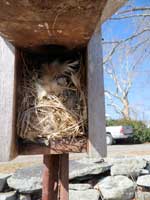
House sparrow nest

House wren nest
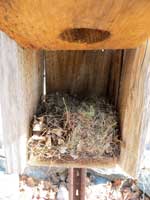
field mouse nest
We have had a couple of pileated woodpeckers checking out snags in the woods behind the pond; it would be great if these magnificent birds decide to nest close by. The juncos, which the old timers called snowbirds, are still hanging around and have yet to start their journey north.
On a positive note and a sure sign that spring is on the way, a male cardinal was feeding seed to a female beneath our feeder, a first sign of courtship.
Audubon Mass. Birders Conference
Pam and I went to the Mass. Audubon Birders Conference a couple of weeks ago. Joel Greenburg discussed the extinction of the passenger pigeon. One flock, in 1866, described as being one mile wide and 300 miles long, took 14 hours to pass and held in excess of 3.5 billion birds. That number, if accurate, would likely represent a large fraction of the entire population at the time.
It is hard to believe that that number of birds became extinct, but due to shooting for food, the species was decimated and the last passenger pigeon, Martha, who was kept at the Cincinnati Zoo, died in 1914. On this 100-year anniversary of that sad occasion, Joel is co-producing a documentary, “From Billions to None,” to raise public awareness of our impact on the natural balance of things.
Dr. John Kricher, discussed the effects of climate change on birds. Some insects are hatching earlier. The problem with this is that for thousands of years birds have timed their migration on the availability of food and beneficial weather patterns. Whether it is insects, fish, or fruit, this ecological disruption on birds is already having a negative impact.
If you would like to learn more about ecological disruption, I suggest you go to www.audubon.org/sites/default/files/documents/bacc-ecologicaldisruptioninmotion_feb2009.pdf,
Climate change playing a role?
Climate change may also be affecting birds’ migration patterns. With more extreme weather events, the chance of migration being disrupted is increasing.
Yet another speaker talked about weather and its significance to birds. One of the tools he uses to anticipate the movement of spring migrants to our area is the wind map, http://hint.fm/wind/. For the avid birder this website shows the surface winds and it is easy to see when southerly winds may be pushing spring migrants into our area. On a recent visit to Museum of Modern Art in New York, we were surprised to see this wind map as part of the museum’s design collection. It is cool to look at.
Another contributor that is affecting bird population (as well as ours) is the amount of chemicals ending up in our environment. It worries me that the town is considering spraying for mosquitoes, which is ineffective, a waste of money, and could well be disastrous for our birds and bees.
People may assume that animals will, in time, adapt to changes in the environment as some have over the years. The fear now is that the changes are so rapid that evolution will not keep up and the extinction of species will accelerate.
David Durrant lives with his wife, Pamela, on East Bare Hill Road at Micheldever Farm, where they watch birds —their own peacocks, chickens and visiting wild birds.