Some habits are hard to shake, perhaps with good reason. With the ink barely dry on Harvard’s 2018 charter, the Select Board wants to delegate preparation of the annual budget to the Finance Committee, reverting to a tradition in Harvard that goes back decades.
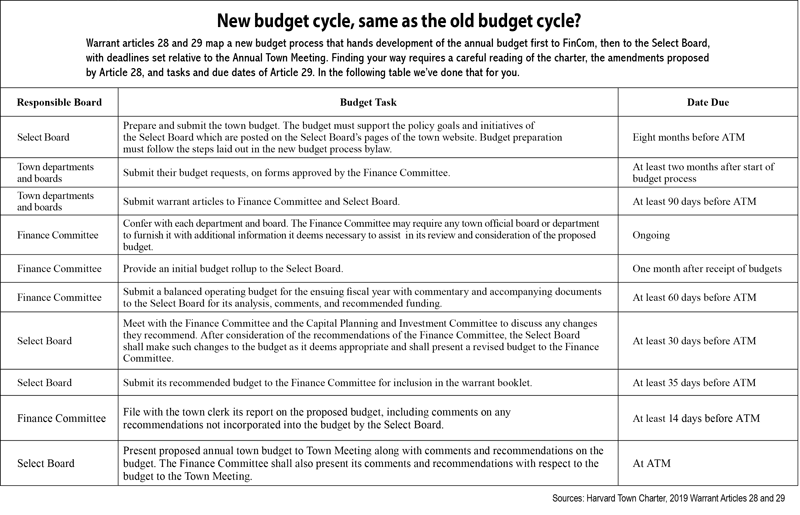
Making the changes requires passage of Articles 28 and 29 at Saturday’s Annual Town Meeting. The first alters the charter itself and, if passed, would need the approval of the state Legislature. The second article creates a new “budget process” bylaw that maps the path the Finance Committee and Select Board must follow in preparing an annual budget, with due dates relative to the date of Annual Town Meeting in a given year, rather than absolute.
Article 28, “Charter Changes,” is the most consequential, with sections that flip the roles of the Select Board and Finance Committee. Under Harvard’s recently passed charter, the task of assembling a first-draft annual operating budget goes to the Select Board, which sets goals and parameters for the year and vets the requests of town departments and committees. The charter requires the Select Board to hand off a balanced budget with an accompanying budget message and supporting documents to the Finance Committee. It’s then up to FinCom, in its role as citizen watchdog, to review the work of the Select Board and recommend adjustments as it sees fit. If there are differences, they are to be reconciled in a joint meeting, but the Select Board has final say.
Article 28 proposes to return the task of preparing the budget to the Finance Committee, while making the Select Board the final arbiter. FinCom gets back its job of vetting the proposed budget of each department and committee, and of assembling a consolidated budget that balances revenues and expenditures. When the time comes to present the budget to town meeting, it is the Select Board that must explain and defend its appropriations.
In a recent interview, Select Board Chair Lucy Wallace compared the change to an organization with a chief executive officer and a chief financial officer. The Select Board is delegating the task of preparing the budget to a committee that has the institutional knowledge and financial expertise to do the best job for the town, she said.
A budget process bylaw
Article 28 alters the responsibilities of the Select Board and Finance Committee, but Article 29 spells out the details of the process to be followed in a new budget bylaw. The bylaw lists the actions to be completed with due dates, set relative to the date of the next annual town meeting (see the table below for details). This makes for a more flexible schedule that will be easier to amend in the future. A nonprotective bylaw can be amended by a majority vote of town meeting, but amending a charter requires the approval of the state Legislature.
The two articles have the near unanimous support of members of the Select Board, Finance Committee, and Capital Planning and Investment Committee. Wallace and Select Board Vice Chair Alice von Loesecke are on board. “The changes … allow the Finance Committee to proceed with the detailed vetting, without the SB having to duplicate that process,” von Loesecke wrote in an email to the Press. “The proposed changes result in a more efficient approach than the current charter calls for, but also ties the [Select Board] into the budget at the strategic level, which was not the case prior to the charter.”
No discernible difference
Finance Committee Chair Don Ludwig agrees. While he doesn’t believe the town will notice any discernible difference, he wrote in an email, “my hope is that the process will be less burdensome for the departments.” The change “takes us back to the old way of budgeting,” but the Select Board, not the FInance Committee, will start the process by hosting an early all-boards meeting to establish departmental priorities and set the budget goals for the year. “I believe it is a more efficient process and made this point several times in our meetings with the Charter Commission throughout their process.”
Paul Cohen, who chaired the nine-member charter commission, opposes the changes. “I had anticipated a longer period of operation under the recently enacted town charter prior to any material changes being brought forward for adoption,” he wrote in an email, adding that no town official had asked him to comment on the changes. “The budget is a policy document that should reflect the priorities and direction of the Select Board, which is the chief executive office of the town. The Finance Committee’s role is to serve as the advisory committee to town meeting, which is the town’s legislative body. The proposed change would modify this role to one of budget originator.”
Whether the Select Board or Finance Committee is first to prepare a budget makes little difference to Town Administrator Tim Bragan and Assistant Town Administrator Marie Sobalvarro. They’re the ones, together with Finance Director Lori Bolasevich and Treasurer Amy Haley, who collected departmental and committee proposals, assembled the voluminous three-ring binders provided each member, and collated the questions that the Select Board and FinCom wanted answered. When the numbers don’t add up and cuts need to be made, it is Bragan who scrutinizes the package and recommends what needs to be done. He’s the one who best understands the needs of nonschool departments and where reductions can be made that do the least harm, he said.
An unbalanced budget
This year’s budget is the second drafted under the provisions of Harvard’s charter. The Select Board kicked off the year with its traditional all-boards meeting, setting goals and budget parameters. In hearings held every other week, the board met with every department and committee to review their budgets and examine their requests for additional employees and resources. To avoid subjecting departments and boards to a second round of hearings, the Select Board invited FinCom members to attend the sessions and to include their questions in the budget document prepared by Bragan and Sobalvarro. FinCom member John Seeley believes about half the FinCom members attended every hearing, The rest attended fewer than half. But no department or committee was asked to appear before FinCom during its review of the budget.
However, for the second year in a row, the Select Board failed to deliver a balanced budget to FinCom, violating a key charter responsibility. By the time the board had finished its work, the deadline had arrived for handing the budget to FinCom and there was no time left to deliberate, although Bragan had a menu of potential cuts for the Select Board to consider.
As FinCom took charge, Bragan offered his options to the committee. Departments and committees were asked to cut $164,000 from their fiscal 2020 spending; the schools were told to cut $150,000. The schedule left FinCom little time for deliberation, and in the end the committee accepted every Bragan recommendation except one, his proposal not to pay for the first year of operation of a second van, which the Council on Aging planned to buy with private contributions by the end of the 2019 fiscal year. Two weeks after receiving the budget, FinCom returned it to the Select Board, this time in balance.
“The dates in the charter were just wrong,” reflected Wallace this week. The new schedule allows more time for review, she said, and for changes to the date of Annual Town Meeting.
Nonbudget changes
While Article 28 deals mostly with changes to the budget process, it contains three additional charter changes. Section 1 gives elected boards greater leeway in choosing when to fill vacant seats. Section 3 makes it clear that the decision to hire a director of community and economic development was an option, not a requirement. And Section 4 states that a properly certified finance director may serve as school business manager only if the schools agree to it.
As this week’s Press was being prepared for publication, however, this year’s budget was not a done deal. A jump in the number of Harvard students who plan to attend the Parker Charter School in Devens this coming fall had increased the amount the town must pay for charter school tuition by nearly $100,000, wiping out a $69,000 budget surplus and leaving the town with a $20,000 deficit. FinCom and the schools were scheduled to meet Wednesday night, May 1, to fix it.