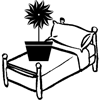
Well, it’s fall, and all good gardens are supposed to go to bed now, all clean, warm, and comfy and having had a bedtime snack. But my garden hasn’t been to bed in more than 40 years, and yes, it’s looking very, very tired, but why start now?

I think this coddling is overrated. A garden can see itself to bed. Eventually, the leaves of the perennials will drift to the ground, their stems will fall over, and their seed heads disperse. As for a snack of fertilizer or a heaping of mulch? Also unnecessary. They’re supposed to be hardy; they can fend for themselves. And wrapping shrubs in burlap? That’s like putting a hand-knit sweater on a dog for a walk in the crisp air.
And tidying up the annuals isn’t always the best idea. A friend gave me a number of zinnia seedlings, which struggled during the hot summer. I should have cut off the browning leaves and flowers to make them look pretty and bloom more profusely. But they survived, and now their tall, though straggly, stems and remaining flowers can be easily seen by the small white butterflies that are profuse in the garden. I think these butterflies are actually cabbage moths, considered pests, but since I’m certainly not growing something healthful like cabbage, I delight in watching them feed on the flowers.
It’s also a time to move some plants to other beds so as to give everyone more room to spread out. Moving plants means more work and more beds to make. Like siblings sharing a bed, let them fight it out. I subscribe to Darwinian gardening: May the fittest survive.
My friend Chris Ready sent me a newspaper clipping a year or so ago called “Let Your Winter Garden Go Wild.” Reading the title, I thought, Bless Chris, she knew just what I needed for added rationalization of my sloth. But, as it turned out, author Margaret Renkl gives wonderful reasons why a garden should never go to bed. “I don’t tuck in my flower beds anymore,” she writes. “Year by year, the little creatures that share this yard have been teaching me the value of an untidy garden. An unkempt garden offers more than just food for the birds. The late offspring of certain butterflies, like the black swallowtail, spend fall and winter sealed away in a chrysalis clinging to the dried stems in what’s left of a summer garden. Others overwinter as eggs or caterpillars buried deep in the leaf litter beneath their host plants.”
She goes on to say that most species of native bees—or their fertilized queens at least—hibernate underground, and yanking out weeds could expose them to the cold, and deep mulch could block their escape in the spring. I certainly don’t want to be responsible for letting bees freeze or smother—they’re already having enough trouble staying alive. Other beneficial bugs spend winter in the hollow stems of old flowers.
Margaret doesn’t exactly say that fallen limbs can be left where they lie, but she does imply that easy access to decomposing wood is a welcome thing for birds looking for insects and small animals seeking shelter. I’m OK with the latter, unless they are opossums. Not that every small animal needs to be attractive, but opossums are beyond the pale. On the other hand, I wouldn’t mind finding, as my new BFF Margaret did, “a nest of thumb-size cottontail rabbits.” If to do so means having a jumble of a garden, with plenty of leaves and dried needles to cover a nest of bunnies, I am happy to accommodate.
The only downside to an unkempt garden—besides embarrassment in front of tidy gardeners—is that I may never find the garden tools I used, sparingly, and mislaid over the summer. On the other hand, that means I don’t have to clean and sharpen them as I’m supposed to do.
Many garden writers argue it’s better to do a fall cleanup and get a head start on spring gardening. They probably really believe that, and they probably vacuum the house every day, too. I do see the efficiency in the idea, but I see more humanity in Margaret’s approach. Anyway, I’m too tired, and I’d rather get me to bed than my garden.
Carlene Phillips, author of “A Common History: The Story of Harvard’s Identity,” is a regular feature writer who pauses from time to time to reflect on the humor in the everyday.
Editor’s Note: An earlier version of this column appeared in the Nov. 7, 2019, edition of the Harvard Press.