
The nor’easter that blew through Massachusetts over a week ago brought heavy rain and cold temperatures, weather conditions that are unusual for late May and disconcerting for local farmers. Although it is still fairly early in the growing season, orchards in town are already feeling the impacts of the extreme shift in weather, with some reporting delayed plant growth and crop losses.
“Farming is the one job where you’re completely at the mercy of mother nature,” Katie Carlson, the manager of Carlson Orchards, told the Press in an interview this past week. Carlson said she won’t know for certain how much the recent weather has affected the orchard until later in the season when the trees start producing fruit, but the rain has caused at least minor setbacks.
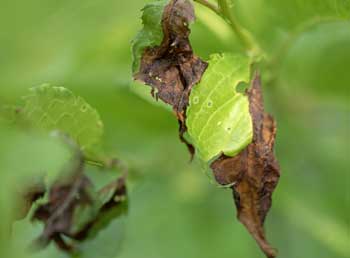
The leaves (above) and branches (below) of tart cherry trees show fungus damage as a result of the large amounts of rainfall this spring.

(Photos by Lisa Aciukewicz).
And if the weather impact is not insignificant for larger orchards like Carlson’s, small farms are at a greater disadvantage and face more immediate consequences when the weather impedes both production and sales. “We lose a lot when it rains,” said Christiane Turnheim, who owns Good Spirits Farm on East Bare Hill Road
Throughout May, towns in the Worcester area accumulated 8½ inches of total rainfall, more than double the normal amount for this time of year. The coldest temperatures reached the low 40s during the recent storms, according to available National Weather Service data.
The soil remains so saturated that some sections of the orchards are flooded with standing water. At Carlson Orchards, one blueberry patch is virtually inaccessible for pruning, Carlson said, adding that she was also worried the rain may have washed away or rotted the field of sunflower and zinnia seeds she planted before the nor’easter.
A walk through Good Spirits Farm offered a glimpse into the flooding issues; the ground was saturated and muddy, with weeds and mushrooms sprouting from the garden beds. Turnheim said the property has a high water table, so excessive rainfall is always a concern for flooding. Because of standing water, the Turnheims have lost a couple blackberry bushes and certain sections of their land are no longer viable for gardening, she said.
In addition to flooding, abundant precipitation also causes leaf fungus and disease, as well as an increase in pests.
Turnheim pointed out the beach plum trees planted along the edge of her driveway, the leaves discolored and fruit buds sparse. The brown, crumbling leaves are due to the spread of a fungus that occurs when the trees are overwatered, Turnheim explained, noting that the trees have never been diseased in the 10 years since she planted them. While leaf fungus is not unusual in cultivated plants, she said, it isn’t normal for native species like the beach plum since native plants should be used to the climate they grow in. And the loss of the beach plums is significant for Turnheim, who sells homemade jams made from the fruit and berries grown on the farm––there won’t be enough of a crop to sell beach plum jam this year, she said.
Turnheim has also noticed an increase in pests in recent years, particularly when the weather is extra rainy during the spring. Good Spirits Farm uses organic farming methods, and Turnheim said she tries to avoid even organic pest spray since it weakens the immune systems of the bees she keeps. Rather, she has installed netting to protect the tomato, eggplant, and ground cherry plants, but said she has still lost crops to pests.
At large farms, a more optimistic outlook
Large-scale farms have integrated pest management and can spray for pests when necessary, but rain interferes with proper management. Carlson explained how orchards need to spray for pests more often when it rains, and yet plants cannot be sprayed while it is raining, so the recent storms put the fruit trees at risk for pests and delayed her ability to respond to the issue. The peach trees had been scheduled for spraying the week it rained, Carlson said, so they had to be sprayed a few days late. “Rain pushes everything back,” she said.
Carlson said it is still too early to tell if the recent stretch of cold, rainy weather will affect the crop yield at Carlson Orchards, but fruit bud growth may be delayed from the cold. A sudden shift to unseasonably warm temperatures, especially so soon after the cold weather, could also cause problems for the orchard. With too much sun and heat, the trees could end up blooming too early, she said. Ideally, Carlson noted, the weather will remain mild for a stretch, allowing the soil time to dry out without causing further stress to the fruit trees.
Chris Green, the owner of Westward Orchards, expressed optimism for the upcoming harvest season. “It has been pretty wet, but at the same time, I wouldn’t start ringing alarm bells yet,” he said. Green said he doesn’t see signs that the trees will have any issues producing fruit, nor does he anticipate any issues with growing the vegetables he planted before the storms hit. Strawberries are in season currently and growing well, he noted, and the blueberry bushes are flowering on schedule.
Green did report that the orchard has yielded fewer cherries and pears than he expected, but he said he was unsure if that was due to the weather. “I wouldn’t say there’s crop loss yet, but it’s still early,” he said. “Hopefully it will be a good season.”
Small organic farms see widespread weather impact
Although still hopeful for a successful outcome, smaller farm owners are concerned by the growth pattern of fruit trees this spring––individual trees are at widely different stages in the growing process, likely as a result of the unseasonable shift in weather.
“Some trees seem to be confused,” said Linda Hoffman, who owns Old Frog Pond Farm. Hoffman observed that some trees in the orchard are in full bloom or even producing fruit while other trees are behind in growth. In particular, she noted how the sides of the trees that are more protected seem to be growing fruit, but the sides more exposed to the elements are sparser.

Bees return to their hive on a sunny afternoon. Pollinators like honey bees have been stymied by the cold rainy weather in which they can’t fly. Even if plants are flowering, the bees can’t fly with wet wings.
Hoffman said the Asian pear trees blossomed prior to the cold stretch and are now plentiful with fruit, but the apple trees are blooming with varied results. On a single apple tree, she said, half the tree had just blossomed with flowers while the other half was already growing apples. “It’s sort of haphazard,” Hoffman said. “I’m disappointed. I was really hoping for a stronger fruit set.”
Turnheim reported similar observations at Good Spirits Farm. She said one plum tree blossomed fully, but another only blossomed partially and now has very few fruit buds. The berry bushes, vegetables, and flowers are also all delayed in growing, she added. “All the plants are negatively affected by all the weather that we have had,” Turnheim said.
Cold, rainy weather this late in the spring not only affects the plants themselves, but also the activity of their pollinators, which in turn, further impedes plant growth, Hoffman explained. Pollinators are not active in such weather, so the nor’easter resulted in a gap between when the trees blossomed and when they were pollinated, she said.
At Good Spirits Farm, the Turnheims raise bees and sell organic honey. Bees cannot fly when it is raining nor when the temperature is lower than 55 degrees, Turnheim said, so the orchards went largely unpollinated during the recent storms, to the detriment of both the plants and the bees. “You can really end up losing your entire harvest because of no pollinators,” she said.
Moreover, when bees are unable to fly and obtain nutrients from plant nectar, they eat the honey stored in their hives, Turnheim continued, which leaves less honey to be harvested and sold. On larger-scale farms that keep bees, farmers will often feed the bees sugar water to preserve the honey, but Turnheim said she avoids doing this because sugar water produces lower quality honey. Honey is the Turnheims’ main source of income from the farm, and this year, they are expecting to harvest far less than usual.
Extreme cold and rain are also unhealthy for the bees, Turnheim said, explaining the effort she and her husband Rene put into protecting the bee hives from extreme weather and disease. Farmers nationwide are projected to lose up to 70% of commercial honey bee colonies this year, Turnheim noted, and poor weather conditions and resulting sickness are a contributing factor. The Turnheims insulated the structure where they house the bee hives with heavy plastic and a heater, but still lost bees to the frigid temperatures this past winter. Turnheim said she feels lucky they only lost two of their dozen hives, but expressed concern that the rainy, cold spring still poses a risk for disease.
‘More and more difficult’
Fluctuations and outliers in seasonal weather patterns, including frigid winter temperatures, excessive spring rainfall, and extreme summer heat are becoming more commonplace as the climate continues changing.
The Turnheims have adapted the farm by building a greenhouse to increase their chances for planting a successful garden each spring, but unseasonable cold stretches and extremely cold winters the past few years have damaged their fruit trees. Turnheim said she no longer plants apple trees in the orchard because of unfavorable weather conditions.
“Changes in the climate have been making it more and more difficult for farmers and orchardists,” Hoffman said, noting that although the fruit trees in the orchard are resilient, they cannot adapt well to extreme shifts in weather. It is also difficult to know how to best adapt farming practices or better care for the trees in a changing climate, she added. “There’s so much that we don’t know that a tree is responding to, there’s so much unknown,” Hoffman said. “Trees are much more sensitive than we even realize.”
In 2023, Carlson Orchards lost its peach crop after an extremely cold winter, Carlson said, and while the orchard had peaches the next year, the trees suffered from diseased leaves because an abundance of rain prevented Carlson from being able to spray the trees. Carlson said she hasn’t noticed so much of a trend in the weather over the past few years as she has a lack of one. “I don’t remember what a ‘normal year’ is because the normal years are gone,” she said. “Farming has its own unique set of challenges. No two days are the same, no two years are the same.”


