

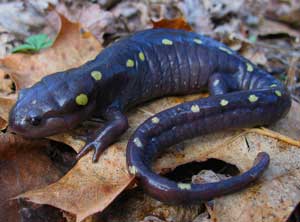
Spotted salamanders are the largest members of the “mole” salamander family, so-called because of their subterranean existence in shrew, mole or mouse tunnels. Usually the only time they come above ground is in the spring, when they perform their annual spring migration and mating ritual. The spotted salamander in this photograph is a gravid female, heavy with eggs. (Photo by Mary Holland)
There are many sights and sounds in the natural world that we humans anticipate, observe, and celebrate every spring. Year after year the first red-winged blackbird’s “konk-la-ree,” the first “quacking” courtship call of the wood frog, or the shrill peep of the spring peeper are welcome harbingers of spring. Even if our eyes don’t spot the creatures making these pronouncements, our ears alert us to their presence. All of these calls are precursors to procreation—love songs, as it were, that capture our attention as well as that of potential mates. Not all spring courtship rituals involve such loud proclamations of love, and, as a consequence, are much more secretive. One such ritual takes place under cover of darkness, in total silence, for the most part on one given night. As a result, this event often escapes notice, at least by humans. It is the annual mass migration of a group of amphibians known as spotted salamanders (Ambystoma maculatum) to their ancestral breeding pools. If you are not aware of this midnight mating march, you are about to become familiar with one of Harvard’s most magical events.
The “big night,” as it’s referred to by salamander sleuths, is actually fairly predictable, although it rarely occurs on the same date every year. On the first warm (45-50 degrees F.), rainy night this month hundreds, in some locations thousands, of subterranean-dwelling, six- to nine-inch shiny black salamanders with bright yellow spots awaken from hibernation, crawl up out of the soil onto the forest floor and begin their annual trek to the nearest pool, up to several hundred yards away, in order to breed. Although for the most part this process happens over a two-week period, the majority of spotted salamanders migrate on the first night. Every year each pool attracts the same individuals plus last year’s offspring. Generations of salamanders have repeated this ritual for thousands of years; a given salamander may make this trip and back as many as 20 times in its lifetime.
Spotted salamanders do not breed and lay their eggs in just any woodland pond or puddle; they are actually quite selective. The sites they usually choose are temporary bodies of water that usually dry up by mid-to-late summer, and which, for obvious reasons, do not support fish. These “vernal pools” are essential to the continuation of several species of amphibians, including not only the spotted salamander, but also Jefferson’s salamander, the blue-spotted salamander, and the wood frog. These creatures rely on a fish-free environment in which to lay their eggs, as the lack of such a large, voracious aquatic predator gives their eggs, as well as their larvae, a fighting chance of surviving. These amphibians are so dependent on vernal pools that their life cycles have evolved around the brief viability of such pools. Breeding, egg-laying, and larval development must all occur within just a few months, a price spotted salamanders are apparently willing to pay.
The males’ arrival at the pool usually precedes the females’ by at least a few hours. When they first arrive the males tend to form congregations of anywhere from a dozen to one hundred salamanders. These groups are called “congresses.” Essentially they are writhing balls of slithering male salamanders weaving in and out and around each other. Every so often a single male will exit the congress for the express purpose of wooing a nearby female. The newly-formed pair will perform a courtship dance, circling each other on the pond bottom, placing their heads under each other’s tail as they do so. The male spotted salamander then often climbs onto the female’s back and repeatedly rubs his chin against her. Eventually he attempts to lure his chosen mate away by wiggling the tip of his tail enticingly as he swims in the direction of a sperm packet, or spermatophore, which he has previously deposited on the bottom of the pool. If he is successful, the female will straddle the spermatophore and pick up this packet of sperm with her cloaca, or single opening beneath her tail, allowing her eggs to be fertilized internally. She then departs, possibly to collect other males’ spermatophores, and he heads back to his congress in hopes of finding another dance partner.
Even if you miss the night of migration and there are no signs of spotted salamanders or their spermatophores in the vernal pool you’re inspecting, you may find one or more masses of up to 250 salamander eggs attached to grass stems or branches lying on the bottom of the pool. When the female lays her eggs, each mass is about two inches in diameter, but it often swells to more than twice this size once in the water. Each egg is enclosed in a sphere of jelly about the size of a marble; the entire cluster of eggs is also enclosed in one big gelatinous envelope. Another vernal pool breeder, the wood frog, lays its eggs at approximately the same time, and they closely resemble those of the spotted salamander. The most obvious difference is that the wood frog egg mass lacks the outer envelope of jelly surrounding all of the eggs. At times algae can turn the salamanders’ egg masses green and the presence of a certain type of protein can cause the eggs to turn white.
The eggs will hatch in approximately one month and gilled larvae will emerge. In anywhere from one to four months, the larvae will metamorphose into juvenile spotted salamanders equipped with lungs which allow them to leave the pool and begin their largely subterranean life.


