

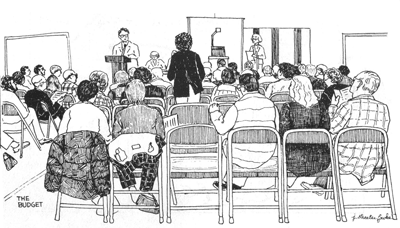
This sketch depicting Town Meeting is one of hundreds done of Harvard scenes, buildings, and activities by longtime resident and artist Janet Streeter Fowke. Fowke’s work appears often on the pages of the Press.
When Town Meeting convenes on April 1, 2014, the issues will bear little resemblance to the decisions facing citizens at Harvard’s first town meeting on July 11, 1732, and those of the next several years. Then, matters of religion came first, while the town took no decisive stand on or responsibility for schools until well into the second half of the century. On the other hand, there are some similarities between then and now.
This year will not be the first time “April fools” have attended a town meeting; they did so on April 1, 1734. From the very first, although not voting on trucks and front loaders, the town was concerned about its roads, and the town moderator has always been an important office and his person subject to close scrutiny. At those early meetings, individuals shaped the future of the town, as they have done and will continue to do at every town meeting since.
1732 attendance not a problem
In 1732, poor attendance at town meeting was not a problem; it was more or less a command appearance. Mr. Simon Stone, who was empowered by the Great and General Court of Massachusetts to “Assemble and chuse Town officials,” issued his warrant for a town meeting in a document of July 3, 1732: “These are to Require all the Free holders and other Inhabitants of sd Town to Meet at the House that we now Meet for the Publick Worship on Tuesday the 11th of this Instant July at 10 of the Clock in the Forenoon…” The notes of that meeting, where Mr. Stone was elected moderator, describe inhabitants of the town having been “legally Warned” to the meeting. Records at least until late in the century continue to say that the “Town met according to Warning.” Although we no longer “warn” residents about coming to town meeting, the word “warrant” perhaps carries the old association.
Harvard’s first town meeting took place in a building north of the present Unitarian church, where a group of people had been worshipping since before the town’s incorporation. The only business was the election of officers for the new town. Twenty-three offices were created under 11 titles: moderator, clerk, treasurer, five selectmen, three assessors, two constables, two tithing-men, two highway surveyors, two fence viewers, two field drivers, and two hog-reeves. In 1737 a pound keeper was chosen, and in 1741 two deer-reeves appear in the list of officials. (Perhaps the latter is an office worth reviving.)
First a minister, then a meeting house
For the next year and a half, the town meetings focused on “settling” a minister and on building a new meetinghouse. A second meeting in July of 1732 chose two men to secure a minister and a place for him to board. At the end of August the town voted to build a new meetinghouse instead of buying the building in which worship and town meetings were then being held. At a September meeting a building committee was chosen and given the dimensions and construction procedure for a new meetinghouse, to be located about one-third of a mile south of the existing one. The “seating of the meetinghouse” (who gets to sit in which pew) received sustained attention on the town’s agenda for the next few years.
By April 1734 the town could turn to other matters, legal obligations in the establishment of every new town of that time: building a pound and stocks. The original pound, built of stone and located on the site of today’s Congregational church, was quite large, suggesting that there were a large number of stray animals. A long record of strays has been preserved, perhaps the work of the office of field driver. The same is not true of the stocks, for which there is no record at all.
The first town meeting in the new meetinghouse was held on August 26, 1734, and a decision made then was an important one for the future of the town. Because of distance from county offices and the poor condition of roads, one town or another frequently tried to persuade other towns to secede and form a new county. Harvard voters chose not to become part of the competition, and thus the town was “freed from charges of building a courthouse and gaol and other charges associated with being a Shire Town” (Nourse).
This decision seemed to set a precedent, as Harvard remained firmly opposed when the matter of forming a new county came up in subsequent year—until it seemed to cease in 1874. That early decision eliminated the possibility of Harvard’s becoming a county seat and the changes such a designation would have brought to the town.
No rush to centralize education
Records of town meetings show 18th-century Harvard as taking no firm direction on education. Initially, school was kept in the center of town, first in the meetinghouse and later in different homes. Then the town was split into quarters, each with its own schoolhouse and autonomous supervisor. Town meetings went back and forth on whether to have a centralized school or keep to the district system. A court order of 1740 to provide a regulated school was ignored. It isn’t until 1790 that records show the election of a school committee, made up of one citizen from each district.
For more than a century the taxpayers themselves were the “department of public works.” Highway surveyors presented reports at town meeting on highways to be laid out or discontinued in various parts of town, and the town voted appropriations. The taxpayer satisfied his share of the highway rate by working a few days a year on the roads. If he were remiss in his labor, he would pay a fine. At town meeting in spring of 1735, a formal vote fixed the price of labor on the roads for men, a team of oxen, a horse and a cart, the rate being lower in the winter (perhaps because rocks don’t “grow” then).
Wanted: A moderator with ‘heroic qualities’
At early town meetings, just as at today’s, the moderator was indispensable. Nourse talks about the noisy and protracted discussions and the frequency with which the moderator would have to call upon the constable for assistance before he could “quell a turbulent broil or the boilings of factious spirit.” The moderator was commonly selected for his “heroic qualities” as well as his knowledge of the rules of order. He needed a “nimble wit and the voice of Stentor” no less than a sense of fairness and good decision making.
The present warrant articles may seem to be less important than some of those put to voters at early town meetings. But in the future, residents will look back to Town Meeting 2014 and see the impact that its voters made on the direction of the town. Let us hope they won’t call us fools.
Source: “History of Harvard,” by Henry Nourse