
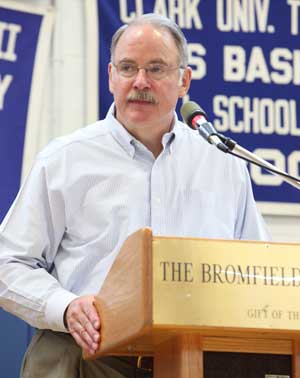
Bob Eubank (Photo by Lisa Aciukewicz)
As Town Moderator Bob Eubank prepares for the upcoming Town Meeting, he is mindful of the generations of moderators and voters who have come before him. “This is all ground that has been walked before, and for hundreds of years,” he says. “It’s people gathered around and making decisions together and having an opportunity to say their piece; it is a wonderful old tradition and the heart of democracy.”
Twenty years after the signing of the Mayflower Compact, New England settlers designed the Massachusetts Body of Liberties in 1641—one of the first American documents to outline protection for individual rights.
While the Body of Liberties advises freemen that if while driving cattle “they be weary, or hungry, or fall sick, it shall be lawful to rest or refresh them in any open space,” it also protects private property from government seizure, gives men the right to a fair trial, and stipulates that punishments should be without cruelty. This language is echoed in the Bill of Rights, proving that small-town Massachusetts government helped form the foundation of American democracy.
The Body of Liberties encourages citizen involvement in government decisions by participating in Town Meeting. In 1641 Nathaniel Ward, the compiler of the Body of Liberties, writes, “Every man whether Inhabitant or foreigner, free or not free shall have liberty to come to any public Court, Counsel, or Town meeting.” This tradition continues today, and it is a unique feature of modern suburban and rural New England.
Eubank has been town moderator since 2008, and this fall marks his 40th year in Harvard. Eubank and his wife were looking for a house in a town with open space and scenic beauty, and they were advised by a real estate agent to come to Harvard.
A strong believer in volunteerism
“We came out and just fell in love with it,” he says. “We found a house quickly and have been here ever since.” Though the town is more developed than when he first moved here, “The general character of the town is the same, the beauty, and that small town sense,” he says. His children attended the Harvard Public Schools, and he now enjoys spending time with his granddaughter.
“I am a strong believer in volunteerism. If you can find a way that works for you to help, then that is good use of your time,” says Eubank. He is a former selectman, library trustee, member of the Zoning Board of Appeals, and the Planning Board.
While the most visible aspect of his current position is running the Town Meeting, the moderator also names members to the Finance Committee. “FinCom is one of the most important committees,” he says; “they are trusted so much by the town to do their homework and investigate.” Their endorsement on particular articles or proposals carries a lot of weight with voters, he adds.
Before Town Meeting, Eubank reviews Robert’s Rules of Order, the official guide to the fundamental rights of a deliberative assembly. He also meets with the town administrator and town clerk to go over the articles up for discussion. “We talk about some of the issues and acquaint ourselves with what is going to take place. We try and get some idea of what may or may not be controversial.” With 52 articles up for discussion this April 1, I asked Eubank if he had any predictions as to what would be hot-button issues.
In past years, he says, voters have been most concerned with larger spending items. But ultimately, “We’re never totally sure, so we will have to see…You can expect reactions from some [topics], but you can expect others to be harmless…[and] there will be a raging debate for quite a while.”
Debate in a respectful manner
The Massachusetts Body of Liberties encourages debate and states that residents are permitted to question any material, present motions, and list complaints, bills or information, so long as “it be done in convenient time, due order, and respective manner.”
If any man “behaves offensively at a Town Meeting,” he will be fined “no more than 20 shillings.” Eubank is not worried about this possibility, however. “We have a great town and a great [populace] and they are responsible and polite,” he says. He has adopted an opening remark from one of his predecessors and reminds attendees, “When it’s all over, we are still neighbors.”
As the moderator, it is important to not be perceived as partisan, and Eubank tries to “remain above the fray,” he says. There is “an extraordinary amount of latitude in what is allowable [at Town Meeting], so using good judgment and common sense is what I try to do.” Though he also admits, “There is a certain amount of lightness in my style.”
Eubank is hoping for a good turnout for this year’s meeting now that it takes place on a weeknight. “The hope is that people who are tied up with normal life activities would find that they could go to the Saturday afternoon soccer games and still make a town meeting on a weeknight,” he says.
This is where decisions are made
Declining attendance at Town Meeting has been an issue for many local towns, not only Harvard. “I think a lot of times attendance is decided by an issue that people really care about,” says Eubank. “And a lot of times I think people think town business is being conducted well, so they are a bit complacent.”
However, he feels strongly that “This is town government, this is where all the decisions are ratified. It encompasses budgets and zoning laws and everything. People should turn out—it’s a civic responsibility.”