
“He’s not out maple-ing,” said Chris Burns of her husband, Jim, on a recent frigidly cold Saturday afternoon. That’s because sap doesn’t run during a cold snap, or even in unseasonably warm weather, said Jim Burns in a later phone interview. “But when it does—I’m out, in any kind of weather, at all times of the day and night.”
Burns is hoping that after this week’s snow thaws out, “things will come back into play.” He said he is counting on a “pretty good sap run on Sunday afternoon and Monday.” For the sap to flow, the nights need to be below freezing, and the days between 40 and 50 degrees, explained Burns. He said that daytime warmth creates pressure in the tree so that, when tapped, sap flows. Cooler temperatures create a suction, shutting off the sap and drawing in water from tree roots. Each day, sap is replenished for about a six-week “sap season” from late February through early April, or until the trees bud out.
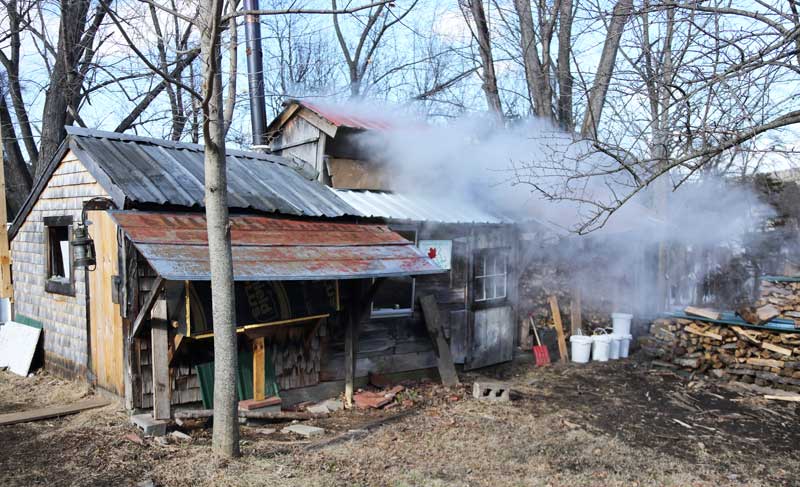
Steam pours out of Jim Burns’ sugar house at the corner of Whitney and Ayer roads and settles over the stacks of wood he cuts to fuel the evaporator. (Photo by Lisa Aciukewicz)
Burns taps 210 sugar maples locally—Shaker Village, Littleton Road, Poor Farm, Slough Road—and produces 55 to 90 gallons of syrup a year. With a ratio of 40 gallons of sap to 1 gallon of syrup, Burns gathers between 2,200 and 3,600 gallons of sap each season from Harvard’s sugar maples. This may seem like a lot, but according to Cornell University’s maple program, healthy trees are not hurt by the relatively small amount of sap taken from each tree.
A family and local tradition
“It didn’t come out of a family tradition but developed into one,” said Burns. “It’s a family operation, a hobby everybody supports in their own way.” He appreciates that his family understands sugaring keeps him extra busy during this time. Burns has been a maple-sugar hobbyist for more than 20 years.
It’s a local tradition, too. “People who know me, buy from me,” said Burns. Not only does Burns distribute his maple syrup through Westward Orchards, but he also has a grassroots customer base of friends and neighbors—many of whom provide trees to tap. Brian Noble of Slough Road is one. He knows that when the Burns family drops off their annual Christmas cookies, it’s a reminder of the upcoming sugaring season. He says he looks forward to that bottle of syrup in late spring.
Once the sap is gathered and brought to the Burns’ sugarhouse—a rustic, slightly ramshackle building located behind their Ayer Road home—it is boiled at length. Usually, a gallon of syrup requires eight hours of boiling, but Burns uses a reverse osmosis process to halve the time.
Cornell University’s maple specialist Steve Childs describes this process as similar to using a water purification system without the carbon filter. A pump pushes the sap through the reverse osmosis membrane separating concentrated sap from pure water. The process is repeated until the sap’s sugar content is 4.5 to 5 percent, says Childs in a YouTube video on Cornell University’s maple program website.
Boiling further concentrates the sugar content of the sap. Initially, explains Childs in the video, sap from the tree is approximately 98 percent water and 2 percent sugar. The finished product, maple syrup, is 33 percent water and 67 percent sugar, according to Childs.
Sugar maple trees around Harvard
Resident and orchardist Libby Levison is tapping her own trees. She started “maple syruping” as a child, even singeing her lashes from being too close to the fire while stirring sap. She had heard that many of Harvard’s older houses had a pair of sugar maple trees planted in their front yards: “I think sugar maples were a New England wedding present,” she said.
According to author Thomas Hubka’s “Big House, Little House, Back House, Barn,” sugar maples were indeed once called “marriage trees.” It was an early 19th-century tradition to plant two sugar maples side by side in the front yard to commemorate a marriage, a birth, or the construction of a new house. The trees were also a symbol of a town’s growth and status as being progressive.
Since it usually takes about 40 years for a sugar maple to reach a tappable size, one can assume that this tradition was meant in part as an investment for the future. According to the Massachusetts Maple Producers Association’s description of how maple syrup is made, healthy sugar maples can provide sap every year for a hundred years or more. Some of these 19th-century maples are trees Burns continues to tap.
Burns spends a lot of time outdoors working with and around trees. When asked about the wildlife he sees, his response was that he didn’t see any this year but “I know they’re looking at me.” About the bear sometimes sighted around Harvard’s neighborhoods: “I haven’t seen the bear recently, but I know there was a bear playing around in my sap buckets a couple years ago!”
What Burns enjoys most are the many sunsets, sunrises, and different lighting of landscapes throughout the day and night. “It’s just what I do,” said Burns.