
The total school budget proposed for fiscal 2023 stands at a little over $18,720,000—about $992,000 above last year’s budget. However, not all that money is expected to come from the town. In the current version of the budget, the schools would seek $14,957,000 from the town’s omnibus budget, while the rest would come from outside sources. The amount the schools request for their operating budget usually makes up about half the town’s total budget.
The main factors driving the fiscal 2023 increase are the COVID-19 pandemic’s effects and school contracts, according to Superintendent Linda Dwight.
The School Committee will vote on its proposed budget next week, after which the budget will move on to the Finance Committee and the Select Board. But fine-tuning that budget will likely continue through the winter and into spring.
For fiscal 2023, the Finance Committee asked departments to “Maintain a service level that is commensurate to an expected progression of service, based on pre-pandemic service levels.” That’s a more generous guideline than last year’s. Facing economic uncertainty when preparing the fiscal 2022 budget, FinCom asked town departments to spend no more than they had in fiscal 2021.
School Committee Chair SusanMary Redinger wrote in an email to the Press, “The schools have prepared a budget we feel is essentially level-service that meets the current needs of the students.”
Factors driving the increase
The schools’ largest single cost increase results from the step-and-grade raises in the Harvard Teachers Association contract. Steps reflect a teacher’s years of service, and grades are based on additional professional and academic qualifications that a teacher earns. An additional expected cost—not yet included in the budget—is the cost-of-living increase in the new HTA contract, which is still in negotiation. That increase covers nonunion school employees as well as teachers.
Other rising expenses are the school bus contract and transportation costs for students going out of the district for special education. The pandemic has also led to the need for an additional person on the cleaning staff, bus monitors to ensure masks are worn, and a third school nurse.
Some children fell behind academically because the pandemic disrupted in-school classes, Dwight said, and other students thrived while learning at home. The result has been a wider range of learning levels in each classroom, not just in academic achievement but also in social-emotional development.
To help all students reach their expected grade level, the district is hiring more learning assistants and tutors and increasing the hours for those that were already on staff. To help with mental health and social-emotional learning, the district is also adding an adjustment counselor, using federal aid money.
School Committee members are also hoping to add a new administrator in the district office. The job title would be director of instructional design, and the position would be a combination of curriculum coordinator and assistant superintendent. This position, Redinger wrote, “has been put off for 10 years due to budget constraints, but is tentatively presented by the leadership team as a critical need to stay current and maintain the quality of education.” Whether the long-sought position is finally added in fiscal 2023 remains to be seen.
Growing reliance on outside sources
Money from an outside source that supplements the school budget is called an offset. Offsets make up the gap between what the town provides to the schools and the total operating cost of running the schools each year. Offsets include state and federal grants, state reimbursements for some special education costs, tuition payments for kindergarten and pre-kindergarten programs, and more.
By far the most offset money in the school budget comes from the Devens fund, which is money MassDevelopment pays the Harvard schools for educating students who live in Devens. At this point, the fiscal 2023 budget includes more than $2 million in Devens money. It helps pay for salaries, technology, athletics, and the school lunch program, for example.
Under this proposed budget, the town would pay about 80% of the school costs, with the rest coming from offsets. That’s about the same share as in fiscal 2022, but slightly less than in the previous three years, when the town paid 83% or 84% of the costs. That’s still less, however, than 15 years ago when the school budget was about half its current size and the town bore 92% of the cost.
Members of the Finance Committee have suggested the town may need an override for fiscal 2023, not only to fund the schools but because of overall rising costs in many departments. But members of the School Committee have said they can manage without an override this year and would prefer to put it off until fiscal 2024, when much of the federal aid tied to the pandemic has expired.
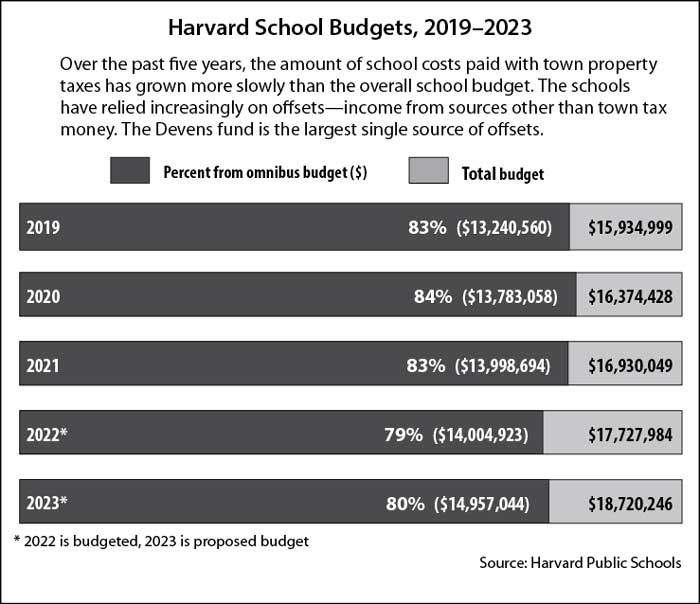
Editor's note: This graph has been corrected and updated. In the original version, the dollar amount for the percentage of the school budget coming from the omnibus budget in 2022 was incorrect.


