
Revised and updated
Judi Burgess grew up in Willingboro, New Jersey, where her family raised her with a strong culture. After graduating from Howard University in 1987, Burgess attended the Villanova University School of Law, from which she earned a Juris Doctor in 1990. Judi worked as an attorney with the National Labor Relations Board in the early ‘90’s in the Philadelphia and Boston regional offices. Judi currently is Boston University’s senior director of labor relations and former co-chair of BU’s inaugural LGBTQIA+ Task Force. She has lived in Harvard with her wife and three children since 2011. From Willingboro to Harvard, Burgess reflects on her experiences with discovering identity and finding community.
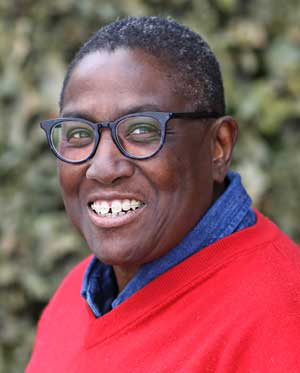
Burgess. (Photo by Lisa Aciukewicz)
I remember the sweet sound of my mom's singing in church. I would fall asleep on her chest, and she would pat me and try to calm me down. Music was always a part of my childhood. I just remember our home always being filled with phenomenal music from The Sound of Music, musicals, and Bach, to Ella Fitzgerald, and lots of really cool, eclectic folk music.
My dad was an African Methodist Episcopal Church minister, and my mom was a high school librarian. We moved from Bridgeton, NJ, when I was around three or four, to Willingboro, New Jersey一a town, at the time, that was a predominantly white Jewish community. I had a very idyllic childhood, very solidly middle class: a lot of teachers, doctors, lawyers, and other professionals. And it was a small, wonderful community at that time.
I stood out. There were not a lot of people that looked like me. But I didn't know that I was different until I got a little older, until people reminded me that I was different. I wasn't really included in a lot of activities by my friends from school at their homes. I remember, like it was yesterday, going to the first—and one of the only—parties that I'd ever been invited to. I had been included as one of the friends, one of the girls. To be invited was special.
When I was an undergraduate at Howard University, it was the first time I was in an environment where I saw others who were racially similar to me. As a person who had grown up in a very conservative religious household in a white, pretty socially conservative community, it was an interesting experience to be in a Black intellectual environment—not just one that was strong, powerful, supportive, and nurturing, but also where I came into my own. I actually protested in front of the South African Embassy to end apartheid. And I had a class with a phenomenal professor, Dr. Ron Walters, called “Black Politics.” He helped inspire me to go to law school.
I don’t know that I was as politically active as I was more of learning about who I was and trying to find my way in the world where there were not a lot of people that looked like me who were out. I didn't know any other women at Howard or at Villanova Law who were openly gay. I remember just going to the bookstores in Dupont Circle when I was an undergrad and literally reading in a gay bookstore all day long, learning about history, our community, and about myself.
I was alive with possibility. Back in the ‘80s, people were going to clubs. In Philadelphia there was an awesome place called Hepburn's, and it was a women's dance club. I would go there when I was home for the summer. My mom was like, “Be careful out there, Juditra.” And I was like, “I'm good.” There was a whole life beyond Willingboro, New Jersey. I didn't know what the future held, but I knew there were people like me.
Honestly, I was probably always out. I don't know what prompted me to say “the thing.” But I remember very clearly having dinner with my dad at a restaurant in Cherry Hill, NJ. I had just broken up with a girlfriend. I literally just came out like, “Dad, you know, I’m lesbian.” My dad was always a very hardcore advocate of women. Back in the ‘70s and 80’s, he just thought his girls were the best things in the world. He was literally a feminist. He told me about how he remembered that he'd gone to someplace where there were women holding hands. So he knew that there are people like that and there was nothing wrong with it, and I am who I am. And then I was asking him, “Well, what do you think Mom's going to think?” And he said, “Well, Juditra, we know you better than you know yourself. And your mom has always known. We’ve always figured you were gay. She might deny it, but she really knows the truth. So you just keep on being yourself. We love you.” He was just the parent I needed.
When I told my mom, she had a very different reaction. I was really lucky that I had that strong support of my dad, because I don't think my mom could really quite wrap her mind around it. She believed I'd become “too educated for my own good”. I think she thought it was something that had happened because of school and education. I think our conflict was also the result of my having cross-cultural and cross-racial experiences that were very different from hers growing up in a segregated Jim Crow South. I think she thought I had been tainted by popular culture. But as it turned out, I'd been saved by culture and people who cared and who did and didn't look like me. I truly was free and able to live my life authentically.
My wife, children, and I have been in Harvard for over a decade. And we just love it. We discovered our home in the middle of winter. There was knee-deep snow. and we took a hike in the woods behind our home, and it was quiet, peaceful, and beautiful. Then we went to the General Store, hung out, and met people who live in the community. Everyone was so warm and welcoming. And we went to a Valentine's Day activity with our kids at the old library, and the people were just so loving. It was not even a doubt: My wife and I were just like, “We have found our place.” The people really make Harvard, Harvard. It is the best place for us.
People have real experiences related to the way they look. But all of it is stuff that separates us. Our experiences as humans are incredibly similar. Everyone wants to be loved. Everyone wants to love. Everyone hurts. Everyone fears. We have these common experiences, and it cuts across race, politics, gender identity. Black and lesbian—it's big because people ask about it. They want to know about it. But in terms of who I actually am, I'm a loving parent. I'm a loving spouse. I'm a caring human being who's lost both parents. And those are common experiences that anyone can relate to.
Editor’s note: This is the third in a series of interviews with Harvard residents conducted by Bromfield senior Olivia Ren in fulfillment of the school’s community service requirement. For details, please see the series mission statement below. This online version has been corrected and updated. The text has been edited for clarity and length.
About Harvard Voices
Although Harvard is a predominantly white and middle-class community, we still have so many different types of people here with diverse identities, backgrounds, experiences, and more. My hope is that my project will amplify the voices of the residents of our town who are less heard or have intriguing stories to tell. The series will interview a diverse array of people—perhaps an immigrant, a small-business owner, or even a neighbor from across the street. By publishing their stories I hope to dispel stereotypes, build unity, and demonstrate that everyone, from neighbors to complete strangers, has an interesting story to tell. No matter who it is, each resident here has something to contribute to the community, and we all have something we can learn from them.
—Olivia Ren


