“To make a prairie it takes a clover and one bee,
One clover, and one bee,
And revery.
The revery alone will do,
If bees are few.”
The power of creative inspiration described as “revery” in Emily Dickinson’s poem “To make a prairie” pervades the upcoming exhibit at Fivesparks. The exhibit, “In Awe of Nature: Two Artistic Perspectives,” will display more than 60 botanical prints and flowers by photographer Stephanie Elkort and printmaker Judith Stein.
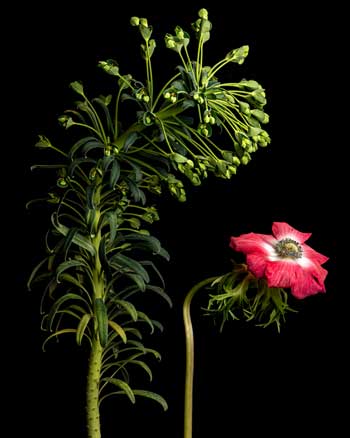
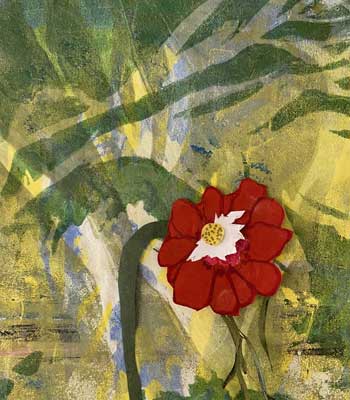
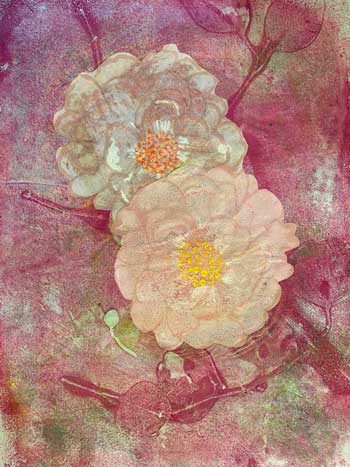
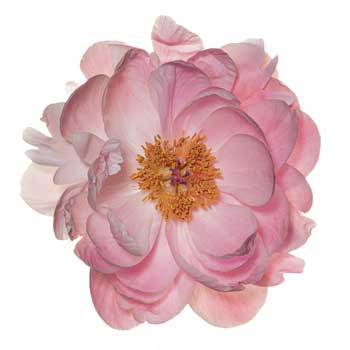
The show features some intentional shared themes such as an anemone and a Chinese peony . (Photos by Stephanie Elkort, prints by Judith Stein)
I was able to preview some of their work at The Center for the Arts in Natick, where the artists had a small exhibit that kept me in motion as I repeatedly stood away from the images to get the overall look at patterns and shapes and then stepped in to examine captivating elements like the veins in leaves or a little face in an orchid. I moved back and forth, gaining various perspectives, examining details, and searching the surfaces for more insight.
Rather than emphasizing similarities in subject matter, the different media employed by the artists highlight their unique aesthetic visions.
Stein creates monoprints on a gelli plate. As is typical of this technique, she may lay actual plants directly on a plate, already “inked up” with acrylic paint. Then, by pressing a sheet of paper over the plate, an image of the plant and some of its details and textures are transferred to the paper by the pressure exerted by hand or with a baren, a printmaker’s tool. When the paper is lifted from the plate, a reverse image is revealed. That process may be repeated on the same print until the artist is satisfied with the image. Stein said, as do many printmakers, that it’s alway a surprise when the print is pulled off the plate. This technique is impressionistic and painterly, has an element of unpredictability and serendipity, resuting in evocative images that cannot be repeated.
Elkort’s carefully developed photographs of plants and flowers, set against plain backgrounds, are printed on subtly textured paper, but, surprisingly, they have a delicate, painterly appearance. In fact, regarding some photographs, she described using a technique involving long exposures called “light painting.” Her photos capture meticulous detail, careful presentation, and precise placement; therefore, the viewer intuits that her choices of plants, containers, arrangements, and techniques are deliberate and intentional, provoking a particular response.
The design of the exhibit is one that will be replicated at Fivesparks. Some of their images of flowers and plants were displayed side by side, as though they were talking to each other. Sometimes the similarities are uncannily alike. Occasionally, the artists deliberately decided to create images of the same plant. In other instances, similarities, such as in color and composition, were coincidental.
I entered a state of reverie as I viewed the art. I was absorbed, delving into the images; finding botanical details; making comparisons with Impressionism and well-known botanical artists, such as John James Audubon, Karl Blossfeldt, and the floral still lifes of Robert Mapplethorpe; uncovering meaning and interpretations in the arrangements; discovering awe by losing myself in nature and art.
The show runs July 20 to Sept. 5. The gallery is open Tuesdays through Fridays from 10 a.m. to 4 p.m., and on Saturdays from noon to 4 p.m. An artist reception for these artists (who are also active in the art centers of Wayland, Sudbury, Needham, and Maynard) will be held at Fivesparks Sunday, July 28, from 3 to 5 p.m.