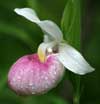
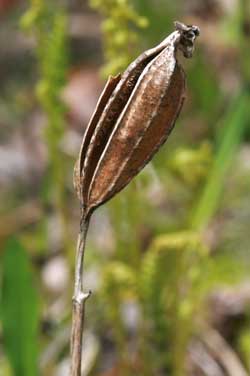
Lady’s slipper seed pod—After pollination, the lady’s slipper’s blossom fades and seeds develop within the swollen ovary. This capsule splits and releases hundreds of thousands of some of the tiniest seeds of any flowering plant. Not even half of these seeds will germinate and of those that do, only 2 percent of the flowers they produce will be successfully pollinated. Fortunately, however, a lady’s slipper lives an average of 20 years (occasionally up to 150 years) and one pod contains up to 60,000 seeds, so with adequate protection they will continue to grace our woodlands for years to come.(Photos by May Holland)
Lady’s slippers, moccasin flowers, whip-poor-will’s shoes—these are some of the common names given to certain members of the orchid family whose lowest petal is enlarged and inflated into a pouch, or labellum. There are about 10 species of lady’s slippers in North America, with the yellow (Cypripedium calceolus), pink (C. acaule) and showy (C. reginae) the most common in Massachusetts. During May and June these three orchids flower, usually yellows first, then pinks, followed by showy lady’s slippers. Theirs is a display of colors, textures, scents, and shapes unlike any other.
Yellow and pink lady’s slippers are found in both wet and dry sites, whereas showy lady’s slippers are most likely to grow strictly in wet areas such as swamp openings and open fens (similar to bogs, but not as acidic). Even if you know the kind of habitat in which to look for different species of lady’s slippers, there is no guarantee that you will find them, as they have very specialized needs. The soil in which these flowers grow must be acidic and it must also contain a certain type of fungus (Rhizoctonia), which is vital to the survival of all lady’s slippers. Rhizoctonia fungi and lady’s slippers have what is called a symbiotic relationship—they both benefit from interaction with each other. Lady’s slippers produce minute seeds which, lacking the food supply most seeds contain that allows them to grow, are dependent upon Rhizoctonia digesting their outer coats so that they can access soil nutrients. The fungi must penetrate far enough to digest the seed’s outer coat, but not its inner cells, in order for the seed to germinate. The fungi also join the orchids’ underground corms, or stems, allowing them to obtain minerals and other nutrients from the soil. Lady’s slippers return the favor by providing Rhizoctonia fungi with food which the orchids photosynthesize.
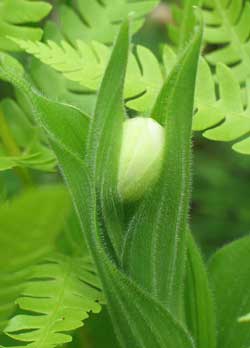
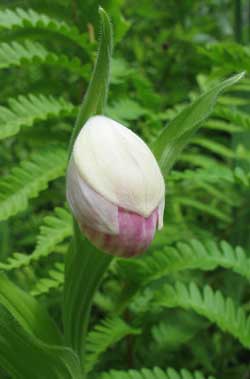
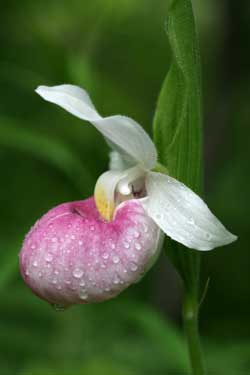
In five to seven years, when a lady’s slipper seed matures into a flowering plant, it uses color, design, and scent to attract potential pollinators. Attraction is simple and straight-forward compared to the mechanizations the insects must tackle once they arrive. The easier it is for an insect to obtain pollen and nectar from a flower, the more likely it is to return to the flower. Flowers with landing platforms and easy access to nectaries and pollen-bearing anthers, such as dandelions and asters, are likely to be revisited frequently. Flowers that present pollinators with time-consuming hurdles to overcome in order to reach the flower’s pollen and nectar are not as likely to receive multiple visits from the same insect. The inside of a lady’s slipper’s pouch is a veritable obstacle course for food-gathering visitors. Insects enter the pouch via a circular opening at the top (yellow and showy) or the pouch’s cleft (pink).
Fine, slanting hairs line the inner surface of the pouch and point towards the male and female structures (as well as the exit), discouraging any attempts of the insect to leave the way it came in. The passage past the female stigma (which combs the pollen that has gathered on the insect’s body) and then onto the pollen-bearing anther (which anoints the insect with pollen) is constricted to such a degree that it prevents the insect from backtracking once it’s begun its exit. The only way out of the pouch for an insect at this point is to squeeze itself through this confined area to the outside. If this proves impossible, larger insects such as bees will sometimes chew their way out of the pouch (look for tiny holes). Smaller insects frequently succumb to predators such as crab spiders which lurk in the inner recesses of the pouch, awaiting a meal.
Because of their popularity, lady’s slippers have received a lot of attention from horticulturalists, but efforts to grow them from seed have been successful only within a laboratory environment. Transplanting often fails, as Rhizoctonia fungi have to be in the new location in order for the lady’s slipper to survive. These factors have led to the protection of lady’s slippers growing in the wild. The showy lady’s slipper is classified as a plant of “special concern” in Massachusetts, and the small yellow lady’s slipper is on the state’s endangered plant list. Enjoy these beauties where you find them.
Naturalist and writer Mary Holland lived in Harvard for many years before moving to Vermont. She can be contacted at mholland@vermontel.net.