There is no doubt that a housing crisis exists in Massachusetts. Rents are among the highest in the nation and housing inventory is at record lows. In recognition of that fact, Massachusetts enacted a law in 2021 referred to as the MBTA Communities Act, which requires all Massachusetts communities that the MBTA serves to have zoning that allows for multifamily housing units to be built.
Harvard does not have an MBTA station, but we are near the commuter rail stations in both Ayer and Littleton. As such, we are classified under the new law as an MBTA-adjacent community. The state has mandated that Harvard must provide zoning for 113 units of multifamily housing at a minimum density of 15 units per acre by right. Our deadline to pass this bylaw at Town Meeting is no later than December 2025. This number (113) may seem arbitrary, but it’s calculated based on our 2020 census data.
The Harvard Planning Board, seeking to be proactive and compliant with the MBTA Communities Act, has spent many hours over the past two years researching multifamily zoning and how Harvard could comply in the most appropriate manner and consistent with local goals and initiatives. We have held multiple public hearings and consulted with experts at the Montachusett Regional Planning Commission and the attorney general’s office to add this new zoning bylaw to our town’s protective bylaws. The state provided a bylaw template with its requirements and the Harvard Planning Board has worked to try to tailor that bylaw, as much as the law will allow, to fit Harvard’s future goals and existing character.
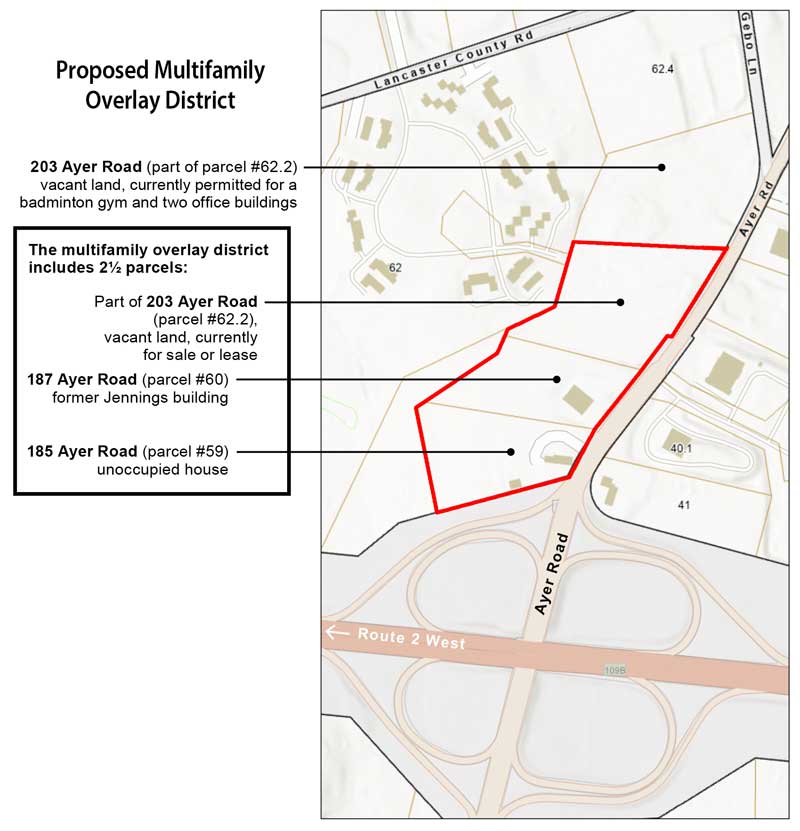
An 8-acre zone at Route 2 and Ayer Road intersection
After much deliberation we first selected three possible sites for the zone, and after input from residents, all relevant stakeholders, and the state, we selected an 8-acre parcel of land at the corner of Ayer Road and Route 2 as the site for our MBTA Communities Act multifamily overlay zone. At the mandated density of 15 units per acre, this could yield up to 120 units of housing, which complies with our requirement for zoning for a minimum of 113 units. The site of the proposed overlay zone is in the commercial district, not in the agricultural-residential district, and it is immediately adjacent to Route 2. We believe this would minimize the impact on the agricultural-residential district and any additional traffic burden to Ayer Road. The Planning Board further believes having residential housing at the gateway to our business district may further serve to bolster economic demand in the district and spur economic growth there consistent with our longstanding goals. (See map below.)
As we have progressed through this process with the state, we’ve had a few frequently asked questions. These are listed below.
What about water and sewer? The state requires the zoning at 15 units per acre regardless of whether the town or parcel selected has the ability to support water or sewer for that density.
How much of the zone is affordable housing? The state caps the affordable units at 10% of the development in a multifamily zone; the remaining 90% will be market-rate units. The affordable units will qualify toward Harvard’s subsidized housing inventory (SHI), by which the state measures a town’s percentage of affordable housing stock.
Who will build the housing? This is unknown. Harvard is responsible for creating the zoning, or opportunity to build, but no one is required to build. The town of Harvard would not be building anything. Parcels are privately owned and will be developed as the owners of a parcel choose. Harvard only sets the zoning.
Will Harvard have any say on proposed projects in the new multifamily zone? Yes. The project would still be required to go through Harvard’s design review process that includes a traffic study.
What if we refuse to comply?
The state will penalize any towns or cities that do not meet compliance with removal of state-funded grants, including funding our town currently uses for infrastructure improvements, including roads, culverts, and bridges. For example, the town of Milton is being sued by the state for noncompliance after a recent town referendum to overturn the zoning.
The Planning Board intends to bring this bylaw to the April 6 Town Meeting for your consideration. We will also continue our outreach to hear resident feedback and answer any questions residents may have. We have an ongoing public hearing scheduled for our meeting on April 1. That meeting will be in person in Town Hall, on Zoom, and Harvard Cable TV. The Planning Board welcomes any feedback or questions from residents. Questions, concerns, and comments may be sent to the town planner, Frank O’Connor, at FOConnor@harvard-ma.gov, who will bring your feedback to the whole Planning Board. Additional links to the state’s informational page about the MBTA Communities Act can be found at the Planning Board page at www.harvard-ma.gov.
We hope you support this proposed bylaw, which will help ensure the continued influx of much-needed grant monies to our town. Vote Yes on Article 22 at the April 6 Town Meeting.
Richard Cabelus is chair of the Planning Board; Stacia Donahue is a member of the Planning Board and the Transportation Advisory Committee.