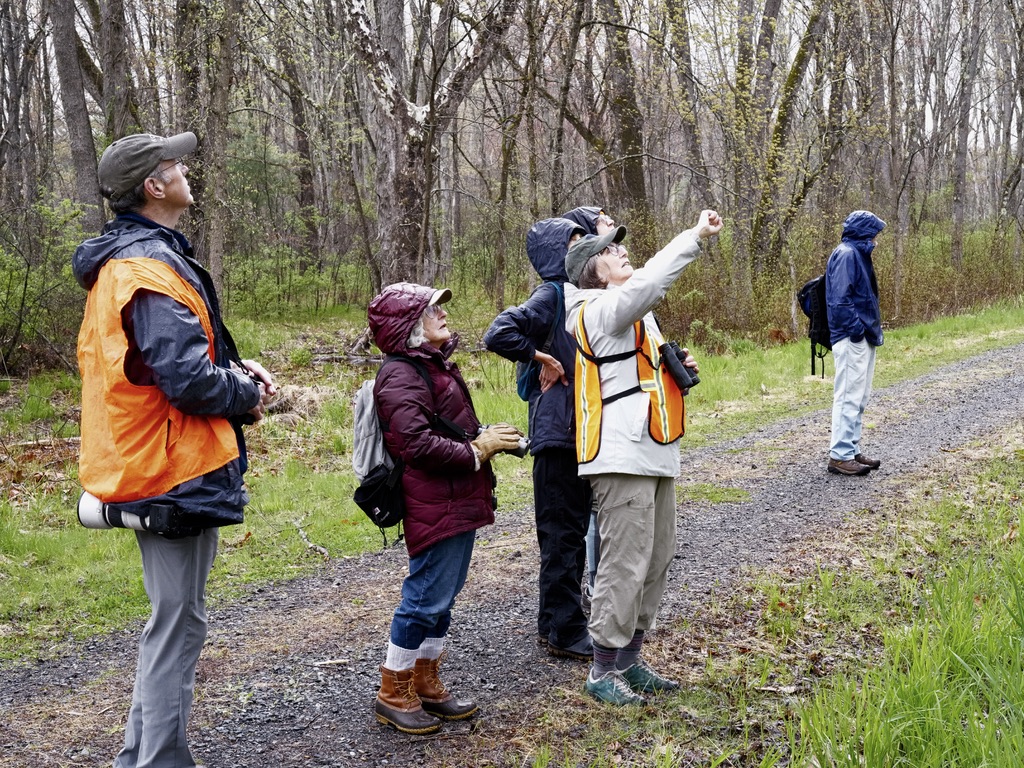
An hour before we gathered in the gray drizzle at Oxbow National Wildlife Refuge, our guide. Liz Markiewicz, made the call: We were going, rain or no rain.
Eight who had planned to make the walk made their own call: They stayed home. The weather was not what they wanted. Indeed, it was not what any of us might have imagined when we first learned of the plans. Harvard’s Fivesparks and Boxborough Birders had planned this walk on May 2 as part of their May program of bird art, bird talks, and bird walks.
Even after our numbers diminished, that left eight of us to gather in the parking lot at the south end of Oxbow. We all wore our rain gear over warm clothes. Seven had birding binoculars. Three had cameras with long telephoto lenses.
Even before the last two had arrived, Sandy Moosbruker, a skilled birder herself, identified an ovenbird by its song. “But we won’t see it,” she said. She was right. Ovenbirds are common but shy. Later we heard three more and saw none of them. Hearing them was enough for Markiewicz to add them to the day’s list of birds.
The weather deteriorated, going from drizzle to a steady light rain. As the photographers slipped their cameras under their jackets, another walker, Susan Richmond, spotted northern yellow warblers feeding on crawling insects high in the crowns of deciduous trees. They were easier to see on this walk, just before the trees had fully leafed out, than they would be a few weeks later.
In the leaf litter at the base of the trees, white-throated sparrows scratched for food. A little further into the refuge, blue-grey gnatcatchers fluttered about in the leaves at the tops of trees. The gnatcatchers beat their wings on the leaves to flush insects and then took wing to capture the flying, fleeing bugs.
When two species of birds feed in the same spot, they generally feed differently, so they do not compete. The jargon is that they “occupy different ecological niches.” The yellow warblers and the blue-gray gnatcatchers both feed on insects at the tops of leafy trees, but they feed differently. Birds do this favor for bird-watchers: they focus attention on variations in nature that would otherwise be hard to notice.
In Massachusetts birders can enjoy seeing birds from the subtropics that come here in the summer (think great egrets) and birds from the Arctic regions that come here in the winter (think snowy owls). For birders, it is a kind of travel without leaving home. The yellow warblers seen in the Oxbow can summer as far north as the shores of Hudson Bay. The blue-gray gnatcatchers, on the other hand, are more southern birds. They can summer as far south as North Carolina.
Susan Richmond, who first spotted the yellow warblers, is an enthusiastic birder who has written the children’s book, “Night Owl Night,” about northern saw-whet owls, and a second children’s book, “Bird Count,” about the Audubon Society’s winter bird count.
At the arts center Fivesparks, the current show includes a yellow warbler in profile. Another work shows an ovenbird perched on a twig, looking out at the viewer.
The walker without binoculars, Rich Ohlin, told us of hiking earlier along the length of the Oxbow trail from Mirror Lake in Devens to the walk’s starting point on Still River Depot Road in Harvard. He pointed out to the rest of us the remains of yards that once made bricks from the clay that they found along the Nashua River. Railroads took the bricks to markets, including Boston. Spots that had been industrial in the 19th and early 20th century now have only collections of broken and discarded bricks. They are wild once again.
In this group, Ohlin had the least experience with birding. It did not matter. He engaged enthusiastically with others. Markiewicz said the next day that Boxborough Birders welcomes novice birders and encourages them.
The walk turned west on a branch off the main trail. This branch led between two marshy ponds, perhaps 40 acres each, in depressions left after brick makers had
scooped out great quantities of clay. It was an area where we might have seen herons or other wading birds, but there were none. Ed Bogle used his telephoto lens to photograph a red-bellied woodpecker on the far side of the larger pond. Another photographer, Shakil Khalifa, took a picture of a swimming muskrat. Even with the long lens, the distant muskrat was quite small. A lone mallard flew by. Later an eagle flew overhead.
Bogle began birding just six years ago, during the pandemic. He began after he saw an attractive bird with a crest at the back of its head. He learned that it was a cedar waxwing—a silky brown bird with a distinctive black mask around the eyes. That led him into the birding world.
During the walk back to the parking lot the rain stopped. The group paused to watch five brown creepers. These small birds with white breasts crawl up tree trunks, searching for insects in the bark. It is a treat for a bird-watcher to spot even one of these hard-to-see birds. To see so many was special. In addition, black-and-white warblers were gleaning insects from the bark.
With the help of others, including Moosbruker, Richmond, and Bogle, Markiewicz had a grand total of 42 birds on her morning’s list. The walkers had met the challenge of the weather and had had a successful walk. Spirits were high as we walked back to the cars.
As Richmond had said when we saw the brown creepers and the black-and-white warblers, “What joy!”