
A new season of the Warner Free Lecture series will kick off Friday, Sept. 23, in Volunteers Hall and will feature three Harvard children’s writers/illustrators who have made it to the “big time.” Sarah Dillard and Elizabeth Atkinson were classmates at Bromfield, and Chris Van Dusen was a year ahead. Now each of them is a published author of not just one but several books. The three authors will talk about their own genre and style, their creative process, and how Harvard may have influenced them in their work; and they will answer audience questions.
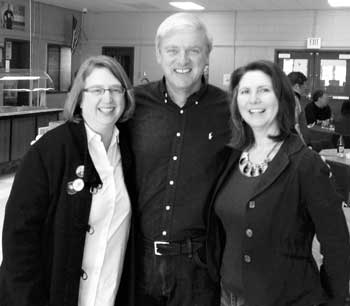
From left: Sarah Dillard, Chris Van Dusen, and Elizabeth Atkinson pose for a photo last April at the Cape Elizabeth Authorfest in Maine. They will be together in Harvard for the Warner Free Lecture, Friday, Sept. 23, at 7 p.m. in Volunteers Hall. (Courtesy photo)
The evening will be moderated by Helen Batchelder of Old Mill Road, a classmate of Dillard and Atkinson who has stayed in touch with all three writers, as they have with each other. All are married and live in New England.
The starting time for this lecture is 7 p.m. rather than the usual 7:30 because after the talk at the library, there will be a reception and book sale and signing upstairs at the General Store. Sign up at the library to reserve a spot at the lecture. The authors’ books are being made available through a special arrangement with the Concord Bookshop. People may pre-order books by calling the store and pay for them the night of the event at the General Store sale and signing.
Batchelder said the idea for the authors to do a talk in Harvard came up about a year ago when she was at a book signing for Atkinson in New Hampshire. In talking about her scheduled appearances, Atkinson casually mentioned that she would love to speak at a Warner Free Lecture. Batchelder took it from there. It was a natural thing to include Dillard and Van Dusen and for her to lead the discussion. “It is going to be so much fun,” she said.
A New England trio
Dillard studied art at Wheaton College and illustration at Rhode Island School of Design. She lives with her husband in Waitsfield, Vermont. Dillard wrote the Extraordinary Warren books for young readers in 2014 and most recently books in the Mouse Scouts series. Asked about coming to speak in Harvard, Dillard said she is excited about the lecture. “I remember going to Warner Free Lectures as a child. Participating in one now, I feel as though I have ‘arrived.’” For the past two years, Dillard has been spending half her time in Harvard, taking care of her mother. She noted, “I’ve written most of my Mouse Scouts books during this time in Harvard, and I have to say, it has made it much easier to tap into my 8-year-old self.”
A writer and illustrator of children’s books, Van Dusen lives in a small town on the coast of Maine with his wife, two tall sons, and a yellow Lab. He studied fine arts at UMass Dartmouth. Van Dusen said that when he was contacted about participating in a Warner Free Lecture, “it was like a blast from the past!” He said he remembers attending the lectures as a kid, specifically one about sharks with Dr. Eugenie Clark, but that he hasn’t thought about them in years—he didn’t know they were still being held. “I’m honored and excited to be coming back to Harvard, and I can’t wait to see the changes. Last time I was in Old Bromfield it was to attend my high school art class,” he said.
Middle-grade author Atkinson has been an editor, a children’s librarian, an English teacher, and a newspaper columnist as well as a fiction writer. She lives in West Newbury. In response to the question about her feelings on returning to Harvard to speak, Atkinson wrote, “Every time I enter Harvard, the decades slip away and I’m a kid again. There’s something so magical, almost whimsical, about this beautiful town. The freedom to roam and explore the woods, the fields, the hills, and the pond with my friends and neighbors shaped my imagination. It made me the writer (and dreamer) I am today. Growing up here was the best possible launching pad I could have had as an author. And coming back and speaking at the Warner Free Lecture series with Chris and Sarah—people I’ve known since way back when—means more to me than any honor or award I’ve ever received.”
The speakers and their books
Elizabeth Atkinson
Author of books for upper elementary school readers
At the heart of Elizabeth Atkinson’s novels is a quirky young person who worms his or her way into your heart and makes you care terribly. They are all needy—social misfits with insecurities—and yet they are wholly without self-pity. Their values are good and true, and they have the pluck and courage to work their way through their difficulties. In the end, each of them is so much more admirable than any of the people to whom they felt inferior that you can’t help but delight in their triumphs. And part of that triumph, in each case, is over a clueless or selfish parent who has been a major part of the problem. All this with fun plot twists, vivid outdoor settings, interesting minor characters, authentic dialogue, sensitivity, wit, and humor.
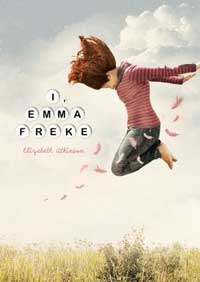
There’s Emma Freke (“I, Emma Freke”), who just turned 12 and whose height and brains “took off one summer as if someone watered me with too much fertilizer.” Now she says she is what her name suggests, “Am a freak,” and she doesn’t fit in with anyone at school. “I didn’t even like me,” she states. Emma’s mother, whom she calls by her first name, Donatella, is a divorcee who “continued to date men with the passion of a high school cheerleader.” Thanks to her one friend, Penelope, a younger, shorter, fellow misfit with a heart of gold; an insightful librarian; and a trip to a family reunion out West, Emma comes to a new understanding of herself.
Ruby LaRue (“The Sugar Mountain Snow Ball”) is in the sixth grade, “friendly, kinda short, tends to wheeze, is a little plus-sized” and has no life outside of school because she has to babysit her 4-year-old twin brothers every day while her dad and stepmom are busy working. If she could pick the perfect job for life, it would be dreamer. “I was dripping with dreams,” she says. Her current dream is to go to the Sugar Mountain Snow Ball, an end-of-the-ski season glamfest attended by a few lucky locals and the Outers, those happy, cool, perfect people who ski at Sugar Mountain and whom Ruby envies beyond reason. With her brainiac friend, Eleanor, and her own ingenuity and sensitivity, she works out what dreams are really important.
Martin Hart (“The Island of Beyond”) is the youngest but perhaps the most intense and complex protagonist of these three novels. In his father’s eyes he “is a very fragile child with a long spreadsheet of issues.” In response to his father’s criticism that he is not a “normal boy,” Martin has retreated to a world made out of toy soldiers he inherited from his father, recasting them as people in Martinsville and endlessly playing “town,” not “war.” He also escapes on his phone to Mutant Minnows. But this summer Martin’s father drives him across six states to the Island of Beyond in a remote area of Maine to spend a month with old Aunt Lenore, doing all the outdoor things his father did there as a boy—all the things Martin abhors. Again, through people who care about him and his own courage and determination, Martin becomes more than his father could have expected.
Sarah Dillard
Author and illustrator of books for early readers; middle elementary school readers
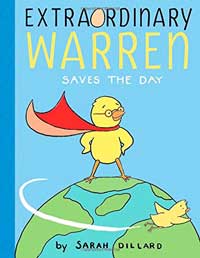
In the Extraordinary Warren books for early readers, Sarah Dillard has mixed a nearsighted but brave and moral chicken hero with an unusually complex plot and delightful plays on words. The drawings do perfect justice to the text. “Extraordinary Warren: A Super Chicken” opens with Warren’s declaration that the other four chickens’ endless pecking all day long is driving him crazy and that he has a greater destiny than an ordinary chicken. The other chickens line up to comment, saying they love chicken feed, love to peck, Warren must be kidding, and the final word—“Peep! Peep!” Meanwhile, on another part of the farm, Millard the rat is also looking for something different from poring through junk every single day. Spotting Warren, he wonders aloud, “Why can’t I get one special chicken?” Warren overhears this remark and is delighted that Millard agrees Warren might be a special chicken; in fact, says the rat, “Chicken Supreme.” Thrilled, Warren rushes to tell the other chickens, not really sure what Chicken Supreme is, but sure it’s some kind of superhero. The plot thickens at Millard’s realization that there are more chickens and Warren’s determination to learn to fly for his new superhero role. Millard, with his recipe book and chef hat, assures Warren that he does not need to fly to be Chicken Supreme—he just needs the right seasoning and a little cream sauce. Reality dawns on Warren, who finally understands the rat’s remark: “I’m looking forward to having you and your friends for dinner,” and he rushes off to warn the other chickens to ignore Millard’s invitation to a barbecue. As usual, they think Warren is hilarious and ignore his warning. But Warren’s bravery wins out. With his new sidekick, Egg, he knows exactly how to interpret the next threat—the fox who says he “loves chicken feed.”
In the first book of the Mouse Scouts series, Dillard does what any good writer of animal books for kids does: She makes the story and characters work on their own level but also lets the reader see the parallel with human beings. So the six Acorn Scouts, newly flown up from Buttercups and facing a tough Miss Poppy as their leader rather than the kind and cuddly Miss Primrose, have distinct personalities. Violet is the worrier, Tigerlily the intrepid adventurer; Junebug lives at the library and has read 1,872 books so far and has allergies; Cricket always has great snacks; Petunia has a crooked tail from a close encounter with a trap; and Hyacinth always looks crisp and polished. The Acorn Scouts are out to earn their Sow and Grow badge, and pages from the Mouse Scout Handbook give them excellent gardening advice—for humans and mice alike. Unique to the mice is their particular garden, with coffee-stirrer stakes for cherry tomatoes and a pencil trellis for the peas. Bugs, slugs, grubs, and even worse invade the garden, and it takes organization, hard work, cooperation, and an ingenious idea to thwart the garden enemies.
Chris Van Dusen
Author and illustrator of picture books, illustrator of books for elementary school readers
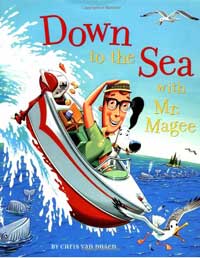
“Down to the Sea with Mr. Magee” is Chris Van Dusen’s first children’s book. The rhymed couplets move the adventure along quickly, and the color illustrations are delightful. Van Dusen is particularly adept at capturing facial expressions, both human and canine. The alarmed faces of Mr. Magee, his dog, Dee, and the seagulls as an unexpected force shoots their boat high in the air are priceless. Mr. Magee and Dee again find themselves high above ground in “Camping Spree with Mr. Magee”—this time on the brink of a huge waterfall. Both books end with the pair safely back in their cozy home after their harrowing adventure, eating a very late lunch or leftover marshmallows.
In 2005 Van Dusen illustrated the first of six in a series, “Mercy Watson to the Rescue,” written for ages 6 to 9 by Newbery Award–winning author Kate DiCamillo. Van Dusen depicted Mercy as a rotund, cheerful looking pig, and her adoring owners, Mr. and Mrs. Watson, as also a bit round. Again, the characters’ expressions of surprise and dismay perfectly capture the many crises of the story. First, the three Watsons, in bed with Mercy in the middle, awaken to the sound of their bed breaking through the floor, dangling precariously, and plunging a bit more as Mercy jumps off. Then one of the spinster sisters next door awakens with terror, thinking Mercy is a monster at her window. The older sister, Eugenia, her hair in curlers, forgoes her false teeth and spectacles to angrily chase Mercy off the property, the smiling pig prancing gleefully just out of reach. In the end all is well, and Mercy sits in front of a tower of hot buttered toast, surrounded by smiling people toasting her as a “porcine wonder.” All but scowling Eugenia.
Ten years after the first Mercy Watson book, Van Dusen and DiCamillo teamed up to reprise some of the characters from that earlier series, written for a slightly older audience. In “Francine Poulet Meets the Ghost Raccoon,” Van Dusen depicts the fearless animal control officer as somewhat bottom heavy with a profile like that of an eagle. At the end of the book, Eugenia appears at Francine’s victory celebration, still with curlers and a scowl, along with the three cheerfully smiling Watsons.
—Carlene Phillips