Corrected and updated Feb. 17, 2016
When readers of The Boston Globe turned to the first page of the paper’s business section on Jan. 21, they were greeted by a photo of former Harvard General Store manager Carin Klem, the store’s trademark coffee cup in hand, smiling and conversing with one of the many customers who stop by for coffee each morning. But the message was not upbeat. “General Stores: Beloved but struggling to survive,” read the headline. And the news was that the Harvard General Store is not immune to the financial problems threatening iconic town-center stores throughout the region.
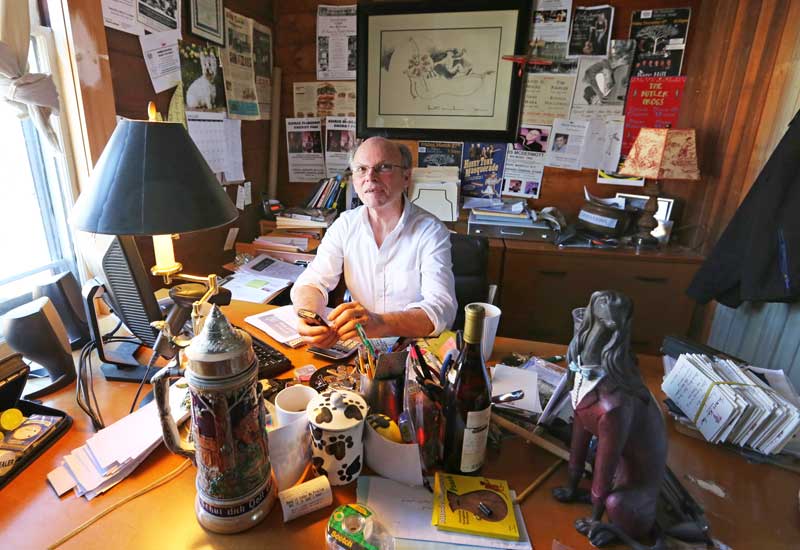
Business owner Scott Hayward returns phone calls and catches up on paperwork in his office at the Harvard General Store. (Photos by Lisa Aciukewicz)
“In the three years since Scott Hayward took over the store,” wrote Globe correspondent Hattie Bernstein, the Harvard General Store has become “more than just a business, attracting activity to the town center, bringing neighbors together, and adding to the fabric of the community.
“But Hayward doesn’t know how long he can continue,” the story went on. With his lease up for renegotiation in May this year, “he’s not sure he’ll renew it.” The problem: a business equation that doesn’t balance—a small customer base and low volume on one side, and the high cost of rent, utilities, personnel, and insurance on the other.
Residents, patrons voice support
By week’s end, Hayward’s statement had morphed into rumors that the store was about to close. Links to the Globe article posted to Facebook and Nextdoor Harvard drew statements of support, a critique or two, and ideas for saving the store.
“It’s as essential as my utilities and way more enjoyable than cable,” wrote Janice Daley of Brown Road on Nextdoor. Regina Fitek of Mettacomett Path wrote that since the article’s publication, news of the store’s problems had been the conversation topic of the “mom-kid” groups of which she is a part. “We love the General Store and all it offers, and I know many families feel the same,” she said in a Jan. 25 post. Tom Gormley of Warren Avenue spoke for other readers who were unaware of the problem in his comment the same day: “I hadn’t realized there was such a challenge.”
In an interview last week, Hayward said he wasn’t walking away, but he confirmed that the problem is real. “[The store] looks successful,” he told the Press. “When the Globe came here they asked, How do you run such a successful business in the face of everything that’s going on and everybody else is going out of business, and I said, ‘Because I’m not.’ It’s counterintuitive. It appears successful. People tell me that all the time.”
No shortage of ideas
On Nextdoor and Facebook there was no shortage of ideas for how to balance the store’s business equation. Some said they’d be willing to pay a monthly fee. Bruce Davidson of Maynard proposed on Facebook that users treat the store “like a church or NPR and tithe money to keep one of your vital community centers open.” If the store needed working capital, wrote Michael Acton of Bolton Road, “I would think that this would be a great opportunity for local crowdfunding … as an investment … in our community.” Brian Smith of Candleberry Lane suggested the formation of a “Friends of the General Store” organization to underwrite its business.
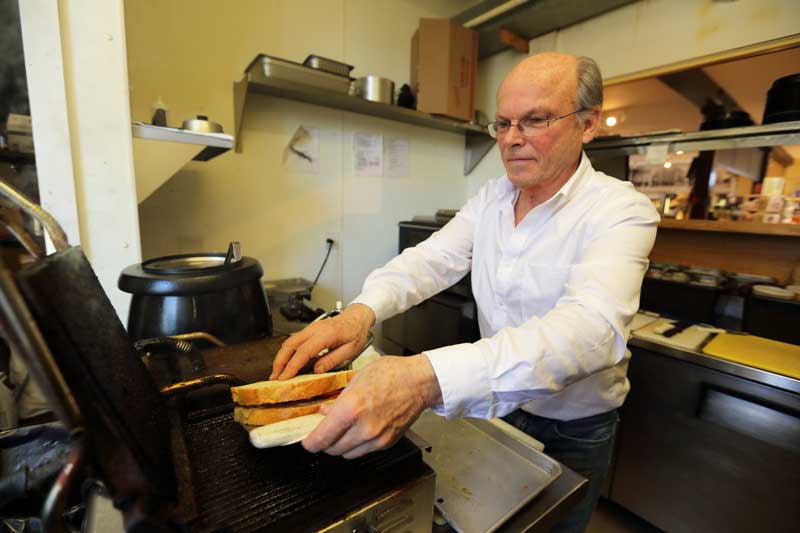
A hands-on owner, Scott Hayward prepares a turkey, bacon, tomato, cheddar, and avocado panini on sourdough during the lunch rush.
There was praise for Hayward’s innovations as a manager, which have ranged from the hosting of a bike shop in the store’s basement and Friday Pub Nights featuring area bands, to his recently introduced Saturday Market Day, which brings fresh produce, meat, and fish from local vendors into the store for winter locavores. A few commenters criticized what’s available on the shelves, with some calling for products typical of a “convenience store” and others suggesting a mix of higher-margin prepared foods typical of a Wegmans or Whole Foods grocery store.
‘I stock what sells’
“Perhaps the best way to help them would be for someone with business skills to look at each item in the store, how many they sell, how much they make off that item, and how many square feet/inches of space does that item take up? Then adjust accordingly,” wrote Jeff Beck of Mass. Ave.
Hayward said he appreciates the support he’s received. “I’ve had people coming in all week with ideas,” he said. “They’re great.” He’s had a lot of people come to him offering to pay a monthly fee, he said, “but I don’t want to get into all that. Just buy a bottle of wine once in a while. Come to a Pub Night … All I’m saying is that to keep the store open, to have a store like this … you’ve got to come in and buy stuff once in a while.”
As for what’s on the shelves, Hayward said that he stocks what sells. “I do a ton of metrics. I come from a metrics background.” He surveyed the town when he opened the store, he notes, and he’s about to conduct another survey, soon to be announced on Nextdoor.
“There’s a certain quality level I drive … That’s what I want,” he said. “I want a value-driven store. But I’m not trying to be gourmet … On the other hand, I don’t think the town wants me to be a convenience store. They don’t want me to be a Quicky-Mart.”
The trust model
Whatever the solution, there needs to be recognition that the store is operating in a very small market with limited potential for growth, said Hayward. “I will be as active as I can, but it’s just limited. … The real work is going to be trying to figure out how to come to terms with that.”
The experience of other New England stores, according to the Globe article, bears out Hayward’s conclusions while offering a potential solution. While stores are failing all over New England, in nearby Petersham and in 10 Vermont towns surveyed by the paper, local land trusts have stepped forward to provide support. In Petersham, a town whose population is one-fifth the size of Harvard’s, the nonprofit East Quabbin Land Trust raised $320,000 and bought the 1840 Greek Revival building that houses the Petersham Country Store, according to the Globe story. The trust rents the first floor to the store’s owner but pays for maintenance costs that would otherwise make operating the business untenable.
While Harvard’s Conservation Trust is focused for now on land acquisition to protect the town’s open spaces, Glen Frederick of Willow Road, a member of its board, said he and his colleagues recognize that the General Store “is hugely important to the town.”
“I look at the General Store as an institution that draws people together and brings them out,” he said in a phone interview. But the trust is not in a position to tackle the General Store. Land acquisition is especially important in Harvard, Frederick said, “because we are so vulnerable.” He added, “That is not to say there are not members of the board who would be willing to help create and contribute to an entity to protect the store’s future. Count me as one of those people.”
Hayward is not yet ready to walk away. “I have a passion to make it work,” he said. “I believe I can make it work … Look at the kind of traffic we have sometimes and look at the kinds of events we have. It’s a pretty lively great place.”
In small towns like Harvard, he mused, “How do these places make it? If they’re so essential to the life of the community, or could be essential to the life of the community, how do they make it? I don’t know if it’s about having the store … In the age of Walmart and Amazon … I think it’s about having a gathering place.”
Editor’s note: This article has been corrected and updated. In the original version, portions of the quote from Adam and Lyn Horowitz in the sidebar were incorrectly edited. This version restores the edited sections of the statement provided to the Press.