“Eleven years, seven months, and two days.” That was exactly the answer you’d expect from Lorraine Leonard, who was responding with some glee to a question about her length of service as Harvard’s chief financial officer, with a precision that those who have worked with her have come to rely on. On Thursday, June 30, Finance Director Lorraine Leonard will retire from her post, leaving empty seats at Town Hall and the schools that have yet to be filled.
“She’ll be a tough act to follow,” said Town Administrator Tim Bragan this week. “She knows her job hands down.” Her knowledge of municipal and school finance, the number of tasks she was able to perform, and her ability to keep everyone informed “was amazing,” and that, he said, is what has made it possible for town departments and volunteer committees responsible for town finances to work together as well as they have during her tenure.
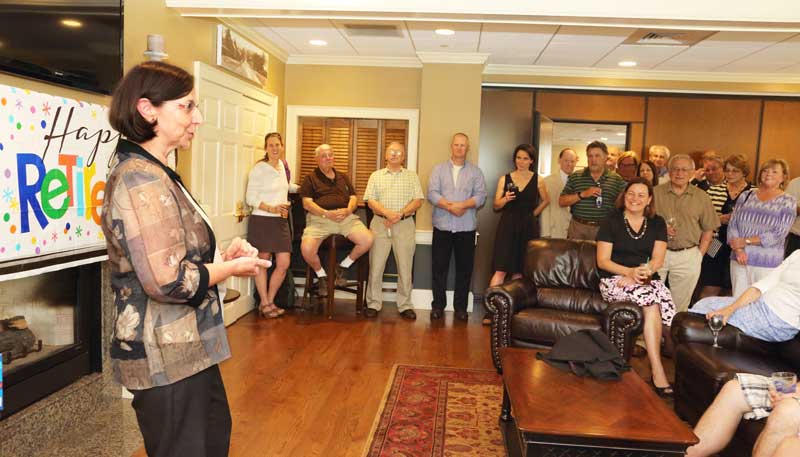
Lorraine Leonard address the crowd at her retirement party at Shaker Hills Golf Club, June 16. (Photos by Lisa Aciukewicz)
In an interview conducted in her newly renovated, sun-filled Town Hall office two weeks ago, Leonard shared her perspective on the town’s finances, the challenges that lie ahead, and her plans for the future. Her years in Harvard overlapped the 2008–2009 financial crisis, the worst since the Great Depression, which led to a loss of state aid and cuts in the town budget and staff. But those years also saw the arrival of a new town administrator, the creation of new mechanisms for managing capital projects, the establishment of a trust fund to cover the future health benefits due Harvard’s employees when they retire, the achievement of an AAA rating from S&P Global Ratings (formerly Standard & Poor’s) for the town’s long-term debt, and a string of balanced budgets with increased amounts of free cash and ample reserve funds achieved without the necessity of a tax override. For a brief interval, after Paul Cohen’s departure for Chelmsford and before the hiring of Tim Bragan, Leonard even served as interim town manager.
From invoices to AAA debt
Leonard arrived in Harvard in 2004, having served previously as finance director for the town of Clinton and as finance coordinator for the Clinton School District. Paul Cohen was town administrator at the time, and she recalls that her first task was to gather all of the hard-copy invoices for the Bromfield School science wing project for submittal to the state’s school building assistance program. “I was told that everything here [in Town Hall] was fine and I could just ignore it and help the school out.” But the town hadn’t closed out its part of the project.
To be reimbursed for the state’s portion of the expense, you had to collect every project invoice and put them all in one box, she recounted. “Not one invoice had been pulled [since the start of the project in 1998] … I was upstairs [in Town Hall], yanking boxes out, pulling invoices. I found every single one of them, put them in one box, and then had all these forms to fill out. After that we had to have an auditor come in and audit the project.” Nowadays, she said, the town’s accounting officer Fred Aponte pulls project invoices as they are paid. “He’s got a pile that’s just for Hildreth House, a pile that’s just for Town Hall, so when [each] is done, he can box it up and say, here’s [what was spent] for the project.”
The accomplishment Leonard is proudest of, she said, was S&P’s award of AAA status to Harvard’s long-term debt in 2014. When she arrived, she recalled, Harvard was rated a AA– municipality, a good rating, one that S&P says indicates a “very strong” ability to meet financial commitments, but not the highest. Over the next decade, however, from 2004 through 2014, S&P increased the town’s debt rating three times, first to AA, then to AA+, and ultimately to AAA status, which S&P defines as an “extremely strong” capacity to meet financial commitments.
In May this year, S&P reaffirmed its rating, assigning Harvard’s long-term debt a “AAA/Stable” rating, indicating that the firm sees no concerns that Harvard’s financial stability will decline in the future. The high rating leads to lower interest rates for the town’s borrowing, Leonard noted. When Harvard issued a new $4 million, 20-year bond to cover the Town Hall project and other recent capital expenses this spring, the town was able to obtain a 1.9 percent interest rate.
A conservative team
Leonard attributes the rating not so much to herself, but to the town’s management of its finances, an assessment that the May 2016 S&P report shares. “We have a very conservative team [that consists of the] capital committee, Finance Committee, Tim, and me,” Leonard said. When the budget is assembled, no one “pushes the envelope” in their forecasts of state and local revenue. The committees aren’t in conflict, she said; they work well together and they all have what Leonard characterized as “a nice conservative balance to them.” Unlike other towns she’s worked in, there’s no pressure to inflate expectations to provide cover for a larger budget. “I’ve never had the [Harvard] selectmen say, no, no, no you’re being too conservative.” The result is a budgeting style that leads to free cash rather than deficits at the end of each fiscal year, she said.
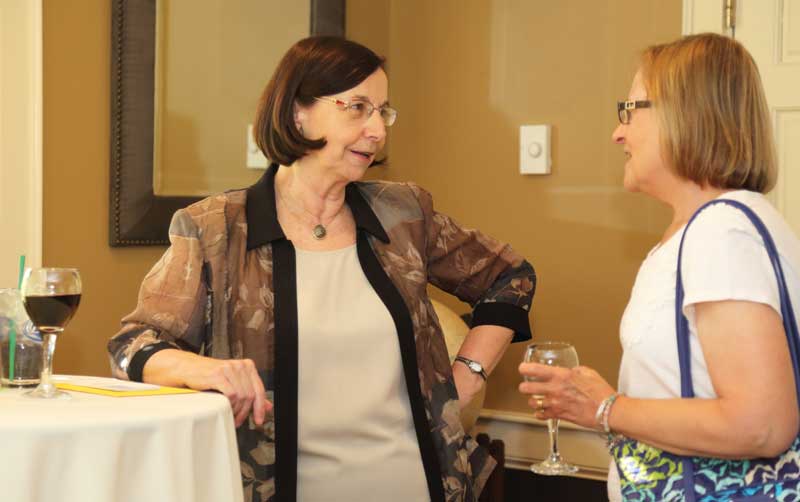
Lorraine Leonard chats with Maryann Cheveralls.
As currently defined, Leonard’s job combines the duties of town finance director and school business manager. Her job description calls for her time to be divided between the two departments, and she hopes that will remain unchanged. “I’m really hoping we find somebody who can do both, because if we don’t, [the job] will be split, and I would hate to see that happen.” Schools have different rules from the town, she said, and it’s helpful to have someone in her role who understands both. When the job is divided, transparency is lost and misunderstandings can arise. “Here there’s none of that,” Leonard said. Finances are all in the open. School reports are shared with the Finance Committee and vice versa. “[Either the School Committee or town Finance Committee] can ask me anything about anything … I would hate to lose that here. It’s a small town. It’s been working well.”
That view is shared by School Committee Chairwoman SusanMary Redinger. “Lorraine’s calm and patient approach made a huge difference for new School Committee members, many of whom had no financial background,” she told the Press in an email. “Over the past 11 years she has worked with at least 30 different school committee members, bringing them through not just the basics, but many nuanced situations. Multiply that by all the boards she has worked with and you begin to get a sense of Lorraine’s contribution to the town. And all the while, she did it with an unforgettable sense of humor and no-nonsense style that made it enjoyable and fun.”
Shocked by criticism of CPIC
Leonard was shocked by the suggestion made at the first Charter Commission hearing that the Capital Planning and Investment Committee (CPIC) be made a subcommittee of the Finance Committee. CPIC, which vets purchases and projects larger than $20,000 or with a useful life greater than five years, works well as an independent committee, she said. During budget season CPIC meets almost as often as the Finance Committee, typically once a week and sometimes on weekends. “Why would you want to make CPIC a subcommittee?” she asked. “I don’t know what would be gained by that.” The Finance Committee is already “very, very busy,” she said. A subcommittee would require Finance Committee members to double the time they spend in meetings, attending both regular and subcommittee meetings. “I’m not in favor of more committee meetings.” CPIC is able to meet independently and then meet with the Finance Committee once or twice a season to share its recommendations, said Leonard. “They do a lot of work.” To have a subcommittee “sounds like too many levels of bureaucracy. It ain’t broke. I don’t know why we’d want to fix it.”
As for what some perceive as a lack of transparency, Leonard countered that the work of CPIC is public. The minutes are online, she said. “Anyone can ask me at any time for the draft capital spreadsheet. It’s not a secret.”
“It worries me when people feel they need to have more jurisdiction over more stuff. I just don’t get it. We’re such a small town. Everything is so open … Anything of note is going to end up in the paper. And if it didn’t end up in the paper, go check the minutes.”
The value of OPEB savings
Leonard also spoke approvingly of the town’s decision to set money aside in a trust fund to cover the health insurance benefits owed future retirees (known as other post-employment benefits, or OPEB). She said she knows there are people who think the town should be putting more in, but said the current amount of $450,000 is “sufficient” and noted by S&P. “We need to be putting something in regularly,” said Leonard. “I just don’t think we need to be putting so much in that we’re cutting other programs, other people, other things. If you pay a smaller amount for a longer period of time, I think that’s more fair.”
In an interview this week, Bragan said what has stood out about Leonard is her dedication. Given the number of meetings she had to attend—night and day as well as weekends—the task was “monumental,” he said. “She was here on the day of the 2008 ice storm,” he recalled, having hazarded a drive to town to make sure the payroll was done on time. “It’s something you don’t see too frequently nowadays. It’s how she was brought up. It’s her work ethic. The town benefitted greatly from it.” And, he added, “She makes the best fudge I have ever tasted.”
Boxes of books
What former Finance Committee chairwoman and current selectwoman Alice von Loesecke will not forget, she said with a chuckle in a phone interview this week, were Leonard’s encounters with Bragan in Finance Committee meetings: “If he ever misstated something or got a piece of information just slightly wrong, you could see it written all over her face. Before she even said anything, Tim would get this look from her, a nonverbal ‘Huh? What are you saying?’ And then she would tell him where he was off.”
Leonard was also a fierce advocate for Harvard in its contract negotiations, recalls Redinger. “Any time we negotiated a contract, whether for Mass Development, the Harvard Teachers Association, or a vendor, she worked to protect the town’s interests.” Redinger recalls one time when Leeonard even suggested an option that would be to her own detriment as a town employee, but that would save money for Harvard.
More than 50 town volunteers and employees turned out for Leonard’s retirement party at the Shaker Hills Golf Club on June 16. What’s next? Leonard, the mother of two sons and a daughter, said she’s going to be babysitting her two pairs of grandchildren for a few days, and then she has “boxes of books,” mostly mysteries, to read. She has no vacation plans for the summer other than a visit or two with relatives on Martha’s Vineyard, where she grew up. She will be working on Wednesdays doing accounting for the town of Dunstable and a half-day a week for Harvard for as long as it takes to find her replacement. When the new hire begins work, she said she’ll work an additional one or two half-days “to give them the lay of the land.” And, she said, she has applied for an open position on Groton’s Finance Committee. “That will give me something else to do.”
“It’s been fun working here,” she said. “It’s had its challenges, but nothing insurmountable. I have thoroughly enjoyed it. It was a good opportunity for me.”