

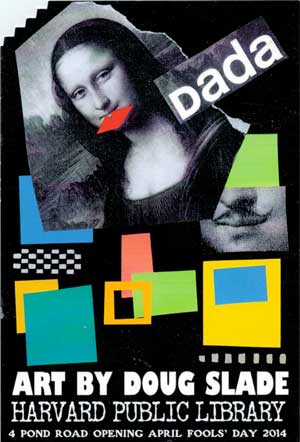
The name of the first-floor Browsing Room at the public library is about to be parodied. And how fitting it is that this will occur on April 1. Starting then, and for the rest of the month, it will be hard to “browse” in this room. As you enter the space, 10 large, boldly colored collage posters of intriguing material will immediately grab your attention. This is local artist Doug Slade’s exhibit: “Born Again Dada.” The exhibit will open with a reception from 3 to 6 p.m. on Tuesday, April 1.
The show is the culmination of the artist’s two-year focus on dadaism, an art—or anti-art—movement that has long interested him and influenced some of his earlier work. But these past months have been spent in total immersion in the dada artists, both in their personal lives and in their individual manifestations of some common principles.
A movement born
in 1916
According to Slade, dadaism began in Zurich in 1916. A group of disillusioned young artists happened to converge on the same cabaret and began sharing ideas about making a statement. Slade thinks a common bond among them was a reaction to the war; whether it was a feeling of freedom or of anger and loss, something fueled a desire for new expression and a kind of rebellion against the establishment.
Looking for a name for themselves, one of the members, Jean Arp, opened a dictionary, pulled out his knife, and stabbed a spot on the page. “Dada,” he proclaimed. To an arched eyebrow, Slade responds, “It’s a great story. It should be true.” Another account, found in H.H. Arnason’s “History of Modern Art,” has the movement born in a gallery in New York in 1915, where two artists “made an anti-art declaration with the intention to destroy traditional standards of taste and beauty” and to question the fundamental validity of art.
A short-lived movement
Whatever its origin, Marcel Duchamp was indisputably at the heart of dadaism, a short-lived movement of lasting impact. Slade says it was like a quasar: “It came and went in a flash.” But he adds, “It had a ripple effect.” Duchamp delighted in satire and paradox. (He would love the incongruity of Slade’s work in the Browsing Room.) In “Nude Descending the Stairs,” a standard of Art History 101, Duchamp uses simultaneous fragments to distort reality. In much of his work he uses what he called “ready-mades,” such as a print of Leonardo da Vinci’s “Mona Lisa” on which he paints a delicate handlebar moustache, perhaps to question historical values in art.
Slade uses the ready-made of Duchamp’s work to create his own poster for “Born Again Dada,” adding his own artistic vision. Slade loves this “ripple” idea and the thought that he is “collaborating” with artists of the past. “Da Vinci, Duchamp, and me,” he says, laughing delightedly.
Asked why dadaism? Slade replies that what he loves about this group of artists is their creativity, the fact that they tried something new. “They thought outside the box and made it work. They ripped things apart and put them back together in a different way. They turned things upside down.” His current work definitely supports Slade’s statement, “I am a dadaist.” He sees elements of dadaism in his earlier work, too. Not, perhaps, in the watercolors he painted on seashells as a kid in Rockport, where he spent summers, although even then he was excited by color. Nor in his photography. But certainly in some of the other periods in his journey as an artist.
‘I get to play like a kid’
The glossy, 2×3-foot posters in Slade’s show begin as 8×11-inch collages. “For me, collage is very exciting. It’s fun and spontaneous. I get to play like a kid. There is no ‘wrong.’” He adds, “Collage is arranged according to the laws of chance.” His work often starts with a special piece of paper that triggers the direction of the piece, or with an image from a book, the outline of which he cuts from paper and glues to his background. Some of his favorite ready-mades are squares of color (paint strips from Home Depot) and matchbox labels from a large collection he bought at a flea market. Slade likes the 8×11-inch size because it is easy to carry around to work with different light and perspective.
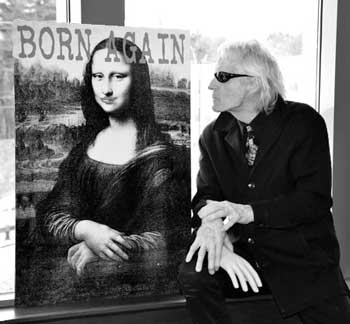
Doug Slade and Mona Lisa. (Photo by Joe Ofria)
Asked if he has a plan when he begins, Slade says, “Yes and no.” He may have a general idea, but he lets one image dictate the next. Sometimes, when he has everything in place for the final glue-down, a draft might stir a part of the design, and often Slade lets this “chance” have its way. When everything is finalized, Slade scans and then enlarges the original. If some tear or smear appears in the final version, Slade usually doesn’t alter it, leaving this further example of chance.
A shared style
Though each poster in the show is unique, there are some “threads” that tie the pieces together. The most obvious is, of course, the dada style. Beyond that, there is a checkerboard pattern and variations of it that recur in several pieces. Images from one work pop up in others—lips and hands— and there are echoes of the work of other artists. Colors, especially yellow and blue, form a connection among the posters. Slade says that he wanted to pick up on the yellow of the walls in the Browsing Room. Slade’s work does not give off vibes of the artistic nihilism of the original movement; instead, the following description of dadaism seems to reflect Slade’s work: “An art of non-representation in which the illusion of nature is completely eliminated and whose end purpose is organization of the artist’s means—color, line, space and their expressive potentials” (H.H. Arnason, “History of Modern Art”).
A place to learn more
Slade says he wanted to do the show so people could learn more about the dada movement. He wants them to see dada as the beginning of something new using the old.” Included in the exhibit are five posters that Slade did as publicity for the Historical Society when he was a board member. Though their purpose was more pragmatic, they are also art. Slade is tremendously grateful to the library staff for all their support, including rounding up the best books on dadaism to have available during the exhibit.
Slade says he’s ready to move on. He thinks he will go back to photography for a while. But he doesn’t really seem ready to let the dadaists go. He is full of awe and enthusiasm for these fascinating “far-out” guys who electrified the art world. “It all got a little nuts,” he says. He relishes their talent and creativity—their art, their poetry, their clothing. “It would make a great movie; that’s my dream.” Maybe Slade will make yet another ripple.
“Born Again Dada” will be on exhibit from April 1 through April 30 in the Browsing Room of the Harvard Public Library.